2026-02-17 スイス連邦工科大学ローザンヌ校(EPFL)
<関連情報>
- https://actu.epfl.ch/news/a-physicist-who-also-grows-trees-investigates-the/
- https://www.pnas.org/doi/10.1073/pnas.2519392122
雨滴から砂玉が生まれる Sandball genesis from raindrops
Bertil Trottet, Daisuke Noto, Douglas J. Jerolmack, and Hugo N. Ulloa
Proceedings of the National Academy of Sciences Published:December 22, 2025
DOI:https://doi.org/10.1073/pnas.2519392122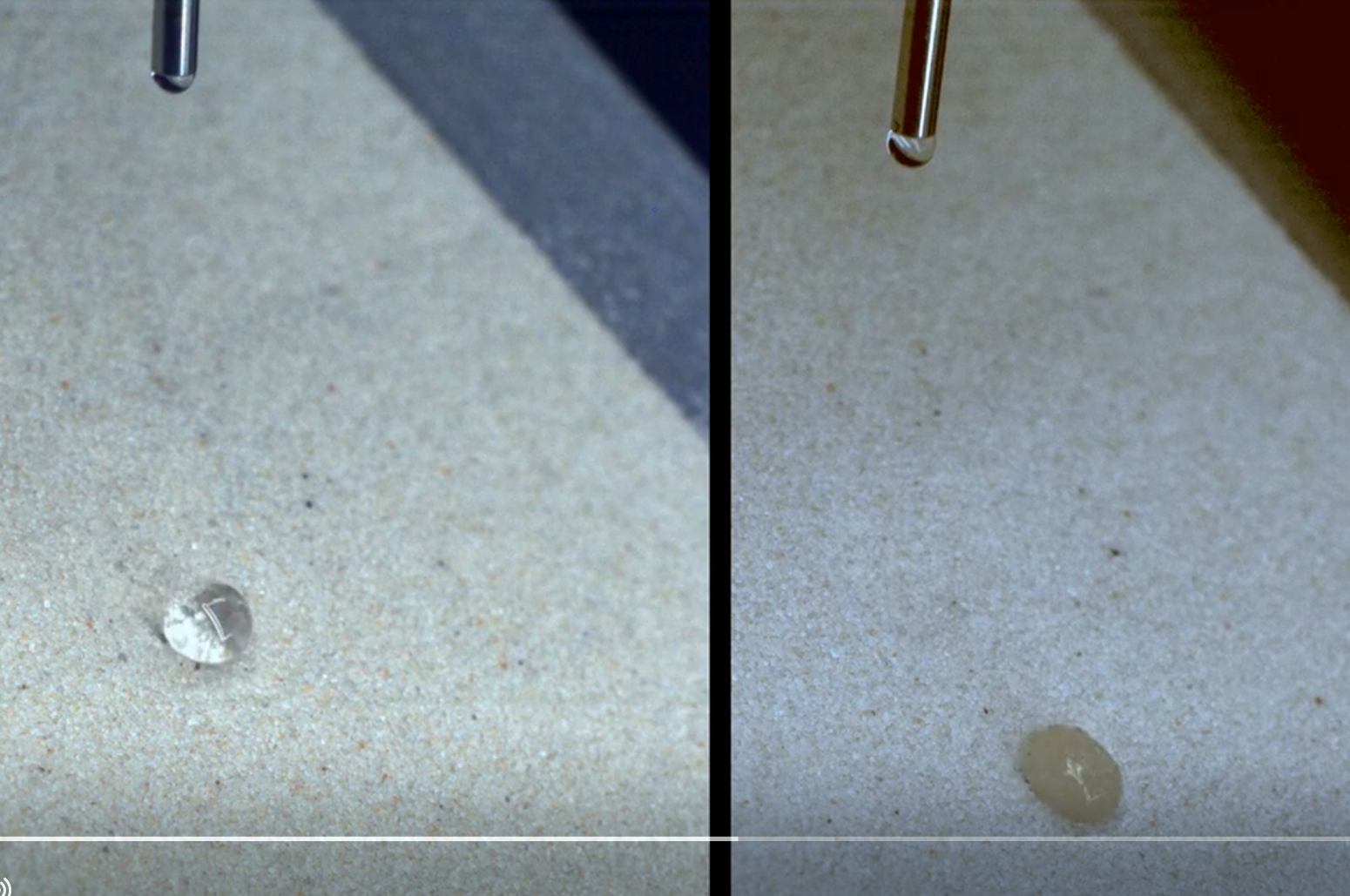
Significance
Raindrops do not just splash—they can roll, gather, and grow. While erosion is often thought to begin and end the moment a raindrop hits the ground, we found that the story continues: On sloped, dry soil, raindrops can roll downhill like tiny snowballs, picking up grains along the way and forming what we call “sandballs.” This process greatly amplifies the amount of soil a single drop can move—by up to ten times—revealing a powerful and previously overlooked erosion mechanism. Understanding how water and soil interact at this scale can help improve models of landscape change, soil loss, and agriculture. It may also inspire innovations in fields like bioengineering, food processing, and snow and soft matter physics.
Abstract
In the water cycle, erosion begins with the entrainment of soil by raindrops. The discrete, discontinuous, and three-phase nature of raindrop erosion—at the boundary of fluid and granular mechanics—makes this problem particularly challenging, compared to better-studied sediment transport by river and wind currents. Past research has emphasized particle entrainment by raindrop splash at impact. Here, we report lab and field observations, that uncover a surprisingly rich and efficient postimpact phase. Raindrops impacting a dry, sloping, granular bed spontaneously form “sandballs;” drops of dense suspensions that can grow in mass to a jammed state by sediment entrainment, as they roll downhill like snowballs and magnify soil erosion. Careful control of drop conditions reveals two stable sandball morphologies: peanut-like shapes linked to hydrodynamic instabilities and toroidal forms that undergo mechanical locking from extreme sediment loading, which have potential implications for related problems in bioengineering, pharmaceuticals, and snow physics.