2026-02-10 中国科学院(CAS)
<関連情報>
- https://english.cas.cn/newsroom/research-news/202602/t20260213_1150972.shtml
- https://iopscience.iop.org/article/10.3847/1538-4357/ae1e7d
ガンマ線バースト残光における光学的暗さの時間発展:GRB 240825Aの場合 Time Evolution of Optical Darkness in Gamma-Ray Burst Afterglow: The Case of GRB 240825A
Rui-Zhi Li, Jirong Mao, Yuan-Pei Yang, Bo-Ting Wang, Fei-Fan Song, Yu-Xin Xin, and Jin-Ming Bai
The Astrophysical Journal Published: 2026 January 16
DOI:10.3847/1538-4357/ae1e7d
Abstract
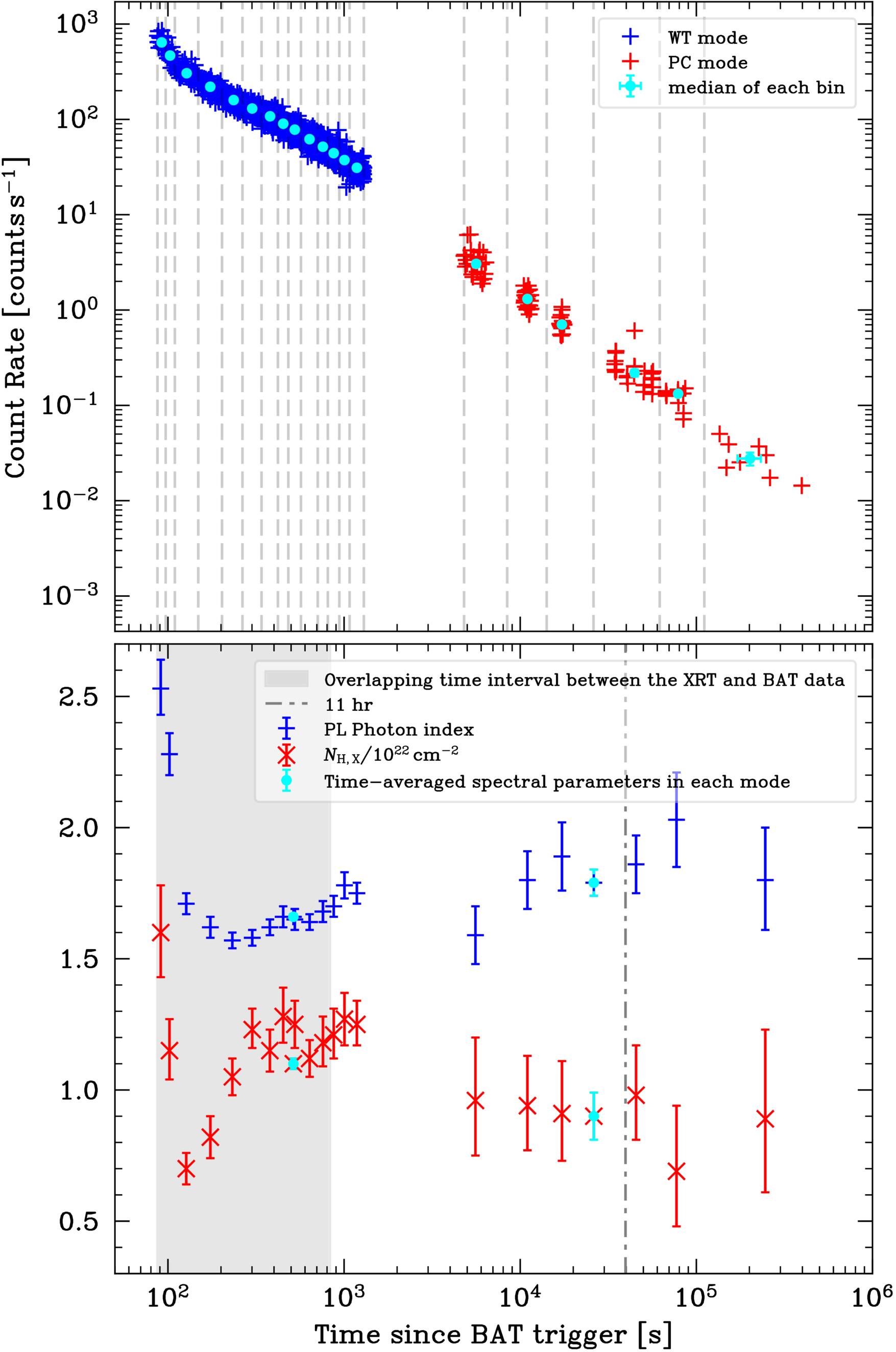
Long-duration gamma-ray bursts (GRBs) are believed to occur in star-forming regions. The multiwavelength follow-up observations of the early afterglow of GRB 240825A provided insights into the evolution of the optical-to-X-ray spectral feature of the afterglow. We comprehensively investigate the evolution of X-ray spectral properties through time-resolved spectral analysis and calculate optical darkness (βOX) to reveal the physical properties of the afterglow. The X-ray-to-optical spectral energy distributions of afterglow in different time intervals are fitted to derive the extinction curves. The βOX exhibits a trend of decreasing and then increasing, reaching its minimum value at ∼1000 s post-trigger. However, at 11 hr post-trigger, βOX does not meet the criteria for an optically dark burst. The extinction curves in different time intervals indicate that GRB 240825A occurred in a dust-obscured environment.