2026-02-06 中国科学院(CAS)
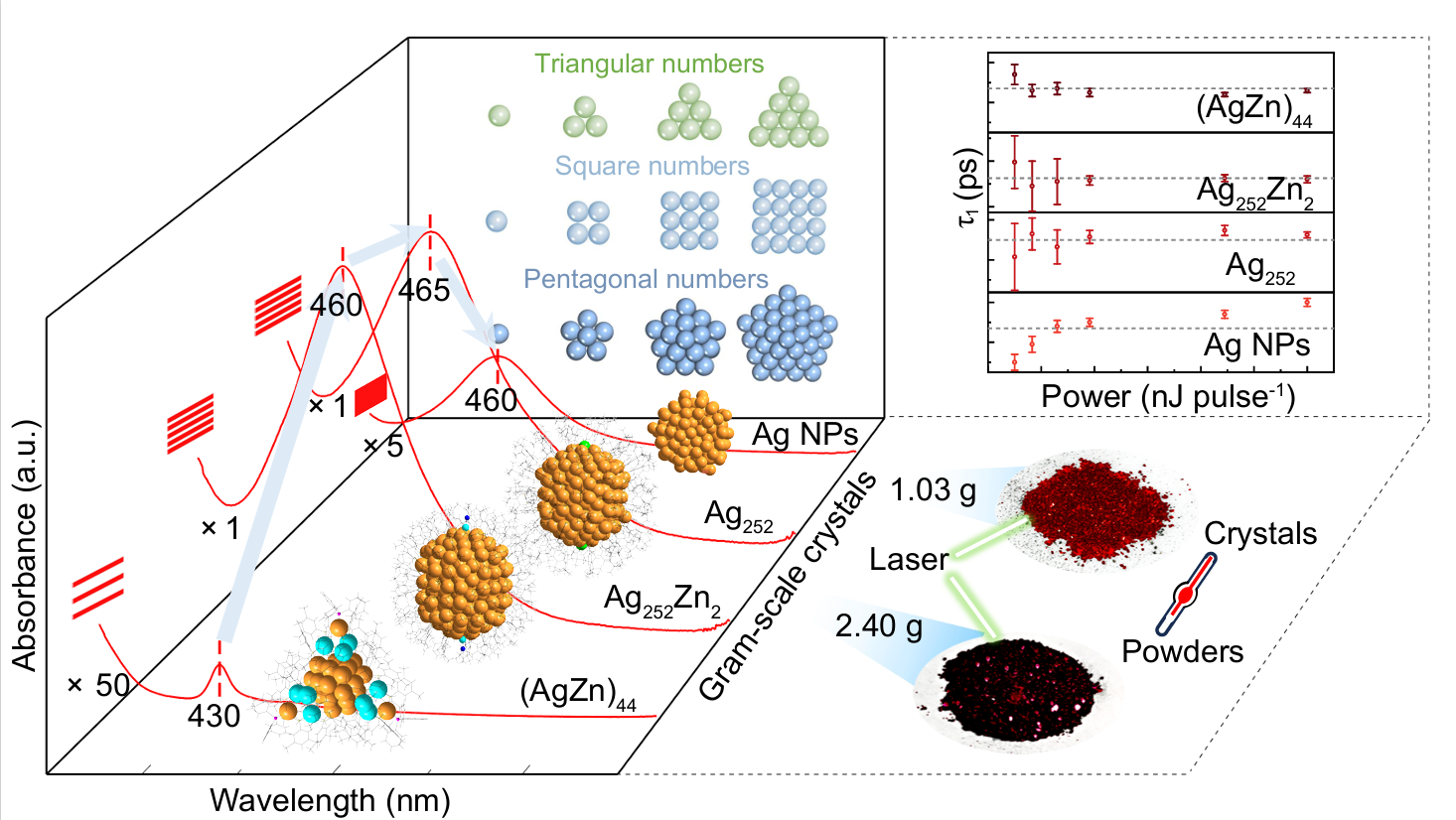
Summary diagram of atomic-scale manufacturing and characterization of Ag-based nanoclusters (Image by FANG Liang)
<関連情報>
- https://english.cas.cn/newsroom/research-news/202602/t20260210_1150425.shtml
- https://academic.oup.com/nsr/advance-article/doi/10.1093/nsr/nwag001/8419693
擬似プラズマ吸収帯を有する分子金属ナノ粒子 Molecular metal nanoparticles with pseudo-plasma absorption band
Liang Fang,Rong Liu,Zongbing He,Guowei Guan,Lingwen Liao,Runguo Wang,Wanmiao Gu,Chengming Wang,Jin Li,Haiteng Deng,…
National Science Review Published:10 January 2026
DOI:https://doi.org/10.1093/nsr/nwag001
Abstract
Metal nanoparticles include molecular nanoclusters and metallic nanocrystals. Investigating the critical transition sizes from nanoclusters to nanocrystals is appealing. However, achieving precise size control near the critical size region remains challenging, especially for not so noble metal nanoparticles (Ag, Cu, etc.). Herein, we introduced an active metal anti-galvanic doping strategy to resolve both stability and multi-dispersity issues and demonstrated the gram-scale synthesis (2.40 g of crystals, more than 200 times the existing crystal output record for over 100-metal atom nanoparticles) of a 1796-atom Ag–Zn nanoparticle. Furthermore, we successfully de-alloyed the Ag–Zn nanoparticles with the remained structure essentially unchanged via a ligand-exchange method, obtaining 1.03 g of mono-silver nanoparticle crystals in a one-pot reaction. Such a surgery-like delloying was not previously reported. Both the as-obtained nanoparticles exhibit penta-twinned face-centered cubic (fcc) structures with well-defined shape-number arrangements and display plasmon-like absorptions yet exist in molecular states as evidenced by ultrafast dynamics measurements. Furthermore, crystallization-induced photothermal enhancement and size-dependent absorbance were observed.