2026-02-10 東北大学
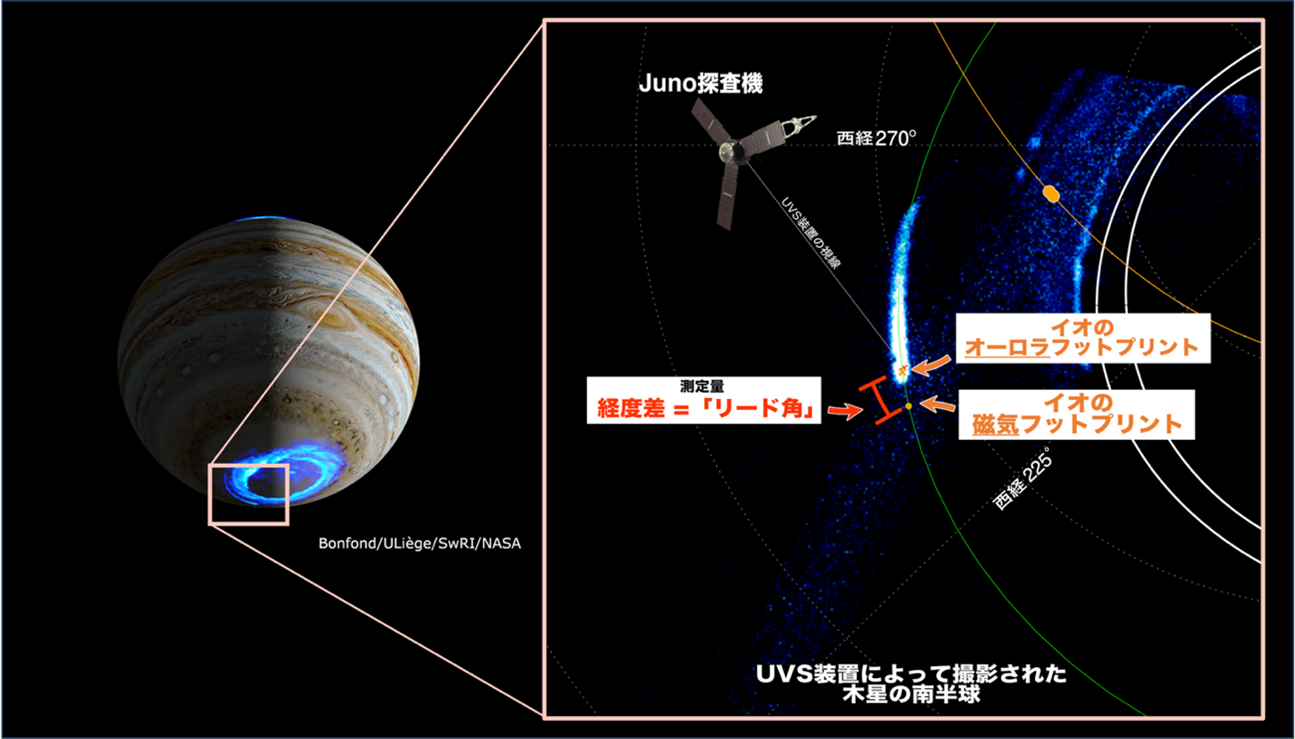
図1. Juno-UVS装置によって撮影された木星の南半球における紫外線オーロラの様子。イオの「オーロラフットプリント」は「磁気フットプリント(=衛星の真の位置を表す)」に対して経度方向にずれており、その経度差を「リード角」と呼ぶ。本研究では、このリード角を測定した。
<関連情報>
- https://www.tohoku.ac.jp/japanese/2026/02/press20260210-01-Juno.html
- https://www.tohoku.ac.jp/japanese/newimg/pressimg/tohokuuniv-press20260210_01web_Juno.pdf
- https://iopscience.iop.org/article/10.3847/PSJ/ae3678
ジュノーUVSによるイオのオーロラフットプリント観測から得られたイオプラズマトーラスの夜明けと夕暮れの非対称性 Dawn–Dusk Asymmetry of the Io Plasma Torus Derived from Io’s Auroral Footprints Observed by Juno-UVS
Shinnosuke Satoh, Vincent Hue, Fuminori Tsuchiya, Shotaro Sakai, Yasumasa Kasaba, Hajime Kita, Masato Kagitani, Alessandro Moirano, Bertrand Bonfond, Hiroaki Misawa,…
The Planetary Science Journal Published 2026 February 9
DOI:10.3847/PSJ/ae3678
Abstract
The Io plasma torus (IPT) is a dense plasma cloud that corotates around Jupiter near Io’s orbit. A dawn-to-dusk electric field shifts the IPT dawnward. The shift orientation has been previously measured, but the observing geometries have limited our understanding of the spatial extent of the dawn-to-dusk electric field in the day–night direction. This study probes the dawn-to-dusk electric field using Io’s auroral footprints. The position of the Io footprint corresponds to the travel time of the Alfvén waves from Io, which depends on the local plasma mass density along the magnetic flux tube connected to the moon. By modeling the Alfvén wave propagation, we retrieved the ion mass density and temperature at Io’s orbit from the footprint positions measured by the Juno Ultraviolet Spectrograph from 2016 to 2022, but the two parameters are degenerate. We found that the flux tube mass content (FTMC)—the total mass integrated along the magnetic field line—is a more robust proxy for variability in the plasma conditions at Io’s orbit. The deduced Io-FTMC is correlated with Io’s local time (LT) in the magnetosphere. The peak Io-FTMC is found at 03:42 ± 00:53 LT, suggesting the dawn-to-dusk electric field is oriented toward a predusk direction. The estimated dawn-to-dusk electric field is 3.0–20.0 mV m−1, with an upper limit exceeding the previously observed values. This may reflect temporal variations in the solar wind dynamic pressure and in the local plasma conditions driven by Io’s volcanic activity over the Juno era.