2026-02-09 コロンビア大学
<関連情報>
- https://news.columbia.edu/news/researchers-announce-discovery-possible-pulsar-milky-ways-center
- https://iopscience.iop.org/article/10.3847/1538-4357/ae336c
銀河中心パルサーの最も深い探査と興味深いミリ秒パルサー候補の調査 On the Deepest Search for Galactic Center Pulsars and an Examination of an Intriguing Millisecond Pulsar Candidate
Karen I. Perez, Vishal Gajjar, Slavko Bogdanov, Jules P. Halpern, Paul B. Demorest, Steve Croft, Matt Lebofsky, David H. E. MacMahon, and Andrew P. V. Siemion
The Astrophysical Journal Published: 2026 February 9
DOI:10.3847/1538-4357/ae336c
Abstract
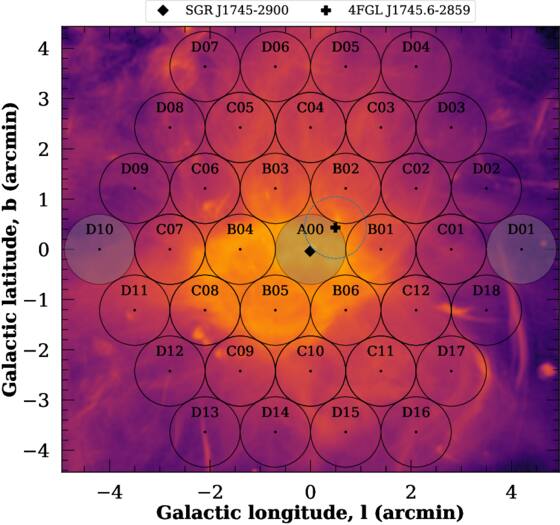
We report the results of one of the most sensitive pulsar surveys to date targeting the innermost region of the Galactic center (GC) using the Robert C. Byrd Green Bank Telescope at X band (8–12 GHz) using data from the Breakthrough Listen initiative. In total, we collected 9.5 hr of data covering the wider~8’ diameter of the GC bulge, and 11 hr on the inner 1’.4 region between 2021 May and 2023 December. We conducted a comprehensive Fourier-domain periodicity search targeting both canonical pulsars (CPs) and millisecond pulsars (MSPs), using constant and linearly changing acceleration searches to improve sensitivity to compact binaries. Assuming weak scattering, our searches reached luminosity limits of Lmin≈ 0.14mJykpc2 for CPs and Lmin ≈0.26mJykpc2for MSPs—sensitive enough to detect the most luminous pulsars expected in the GC. Among 5282 signal candidates, we identify an interesting 8.19 ms MSP candidate (dispersion measure (DM) of 2775 pc cm−3), persistent in time and frequency across a 1 hr scan at a flux density of Smin≈ 0.007mJy. We introduce a novel randomization test for evaluating candidate significance against noise fluctuations, including signal persistence via Kolmogorov–Smirnov tests and flux-versus-DM behavior. We are unable to make a definitive claim about the candidate due to a mixed degree of confidence from these tests and, more broadly, its nondetection in subsequent observations. This deepens the ongoing missing pulsar problem in the GC, reinforcing the idea that strong scattering and/or extreme orbital dynamics may obscure pulsar signals in this region.