2026-02-09 中国科学院(CAS)
<関連情報>
- https://english.cas.cn/newsroom/research-news/202602/t20260210_1150418.shtml
- https://www.nature.com/articles/s41560-026-01980-4
固体配位子交換反応によるn-i-pペロブスカイト太陽電池における埋め込み2D/3Dヘテロ接合 Buried 2D/3D heterojunction in n–i–p perovskite solar cells through solid-state ligand-exchange reaction
Qiangqiang Zhao,Bingqian Zhang,Wei Hui,Kun Gao,Hongpei Ji,Xiuhong Sun,Xiaopeng Feng,Cheng Peng,Kaiyu Wang,Caiyun Gao,Chenyang Zhang,Han Wang,Qi Zhang,Zhenhuang Su,Xiao Wang,Li Wang,Shuping Pang,Stefaan De Wolf & Kai Wang
Nature Energy Published:06 February 2026
DOI:https://doi.org/10.1038/s41560-026-01980-4
Abstract
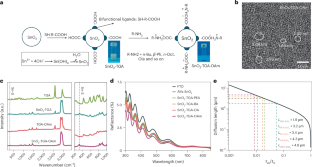
Incorporating two-dimensional (2D) perovskite phases at the interfaces of three-dimensional (3D) perovskite solar cells improves device performance. These 2D structures form in the bulk and at interfaces of the perovskite film by adding long-chain ammonium salts into the perovskite, but achieving them exclusively at the buried interface remains challenging. Here we sequentially graft thioglycolic acid and oleylamine onto SnO2 nanoparticles. The strong chemical bond between thioglycolic acid and oleylamine ensures that cation exchange with formamidinium iodide, a perovskite precursor, occurs only during thermal annealing, creating a 2D/3D perovskite structure solely at the bottom interface. This localized 2D layer accelerates 3D phase formation, enhances perovskite crystallization and reduces defect concentration at the interface by over tenfold. The resulting solar cells achieve power conversion efficiencies of 26.19% (certified 26.04%, 0.09 cm2), 23.44% (aperture area of 21.54 cm2, certified 22.68%) and 22.22% (aperture area of 64.80 cm2), respectively.