
2026-02-05 ゲーテ大学
<関連情報>
- https://aktuelles.uni-frankfurt.de/english/how-superconductivity-emerges-new-insights-from-moire-materials/
- https://www.nature.com/articles/s41586-025-10067-1
モアレ超伝導体における谷間ギャップと多体共鳴の解明 Resolving intervalley gaps and many-body resonances in moiré superconductors
Hyunjin Kim,Gautam Rai,Lorenzo Crippa,Dumitru Călugăru,Haoyu Hu,Youngjoon Choi,Lingyuan Kong,Eli Baum,Yiran Zhang,Ludwig Holleis,Kenji Watanabe,Takashi Taniguchi,Andrea F. Young,B. Andrei Bernevig,Roser Valentí,Giorgio Sangiovanni,Tim Wehling & Stevan Nadj-Perge
Nature Published:04 February 2026
DOI:https://doi.org/10.1038/s41586-025-10067-1
Abstract
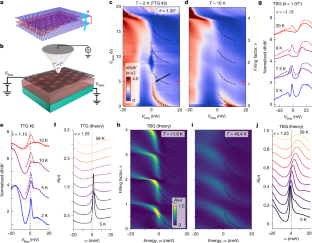
Magic-angle twisted multilayer graphene stands out as a highly tunable class of moiré materials that exhibit strong electronic correlations and robust superconductivity1,2,3,4. However, understanding the relationships between the low-temperature superconducting phase and the preceding correlated parent states remains a challenge. Here we use scanning tunnelling microscopy (STM) and spectroscopy to track the formation sequence of correlated phases established by the interplay of dynamic correlations, intervalley coherence and superconductivity in magic-angle twisted trilayer graphene (MATTG). We discover the existence of two well-resolved gaps pinned at the Fermi level within the superconducting doping range. Although the outer gap, previously associated with the pseudogap phase5,6, persists at high temperatures and magnetic fields, the newly revealed inner gap is more fragile, in line with previous transport experiments1,2,4. Andreev reflection spectroscopy taken at the same location confirms a clear trend that closely follows the doping behaviour of the inner gap and not the outer one. Moreover, spectroscopy taken at nanoscale domain boundaries further corroborates the contrasting behaviour of the two gaps, with the inner gap remaining resilient to structural variations. By comparing our results with recent topological heavy fermion (THF) models that include dynamical correlations7,8, we find that the outer gap probably arises from a splitting of the Abrikosov–Suhl–Kondo resonance9,10 owing to the breaking of the valley symmetry. Our results indicate an intricate yet tractable hierarchy of correlated phases in twisted multilayer graphene.


