
2026-02-03 東北大学
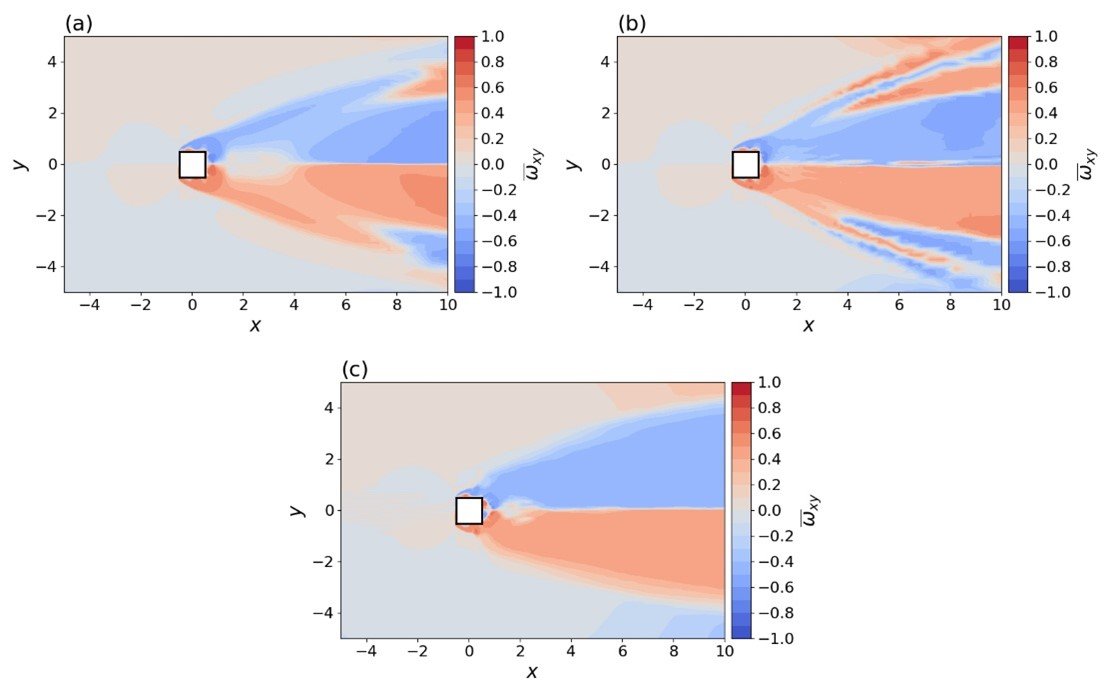
図1. AIが捉えた「風の渦」のシミュレーション比較
(a) スーパーコンピュータを用いたDNSによる正解データ。(b) 従来の低コスト手法によるベースライン。渦の構造がぼやけてしまっている。(c) 今回開発したAIモデルによる結果。低コストな計算でありながら、正解データ(a)と同様に、物体背後の複雑な渦の構造を鮮明に再現できている。
<関連情報>
- https://www.tohoku.ac.jp/japanese/2026/02/press20260203-02-AI.html
- https://www.tohoku.ac.jp/japanese/newimg/pressimg/tohokuuniv-press20260203_02web_AI.pdf
- https://www.tandfonline.com/doi/full/10.1080/19942060.2026.2619155
渦放出の非定常RANSシミュレーションのための機械学習ベースの閉包 A machine learning-based closure for unsteady RANS simulations of vortex shedding
A. Kawabata,A. Yakeno,S. Obayashi & R. D. Sandberg
Engineering Applications of Computational Fluid Mechanics Published:29 Jan 2026
DOI:https://doi.org/10.1080/19942060.2026.2619155
Abstract
Accurate computational fluid dynamics (CFD) simulations of complex unsteady flows, which are critical for aircraft design and certification, are often limited by uncertainties inherent in turbulence models, particularly those relying on the Boussinesq approximation. This study introduces a novel CFD-Driven machine learning (ML) framework utilizing Gene Expression Programming (GEP) to develop an interpretable and integrable anisotropic Reynolds stress tensor closure. Uniquely, this framework incorporates iterative URANS simulations and explicitly targets unsteady flow indicators, representing a pioneering approach to turbulence model development. The methodology was applied to the canonical problem of vortex shedding around a square cylinder, utilizing high-fidelity data generated by an in-house 3D DNS code for training, alongside 2D URANS simulations performed using OpenFOAM. The baseline 2D URANS (based on the Spalart-Allmaras model) exhibited significant discrepancies in both mean velocity and Strouhal number predictions compared to the 3D DNS reference. To address this, the SA model was optimized via the proposed framework using both single- and multi-objective strategies. Our analysis revealed that nonlinear terms primarily drove improvements in the mean velocity field, while linear terms were essential for enhancing Strouhal number accuracy. The improvement in the mean field was correlated with increased mean vorticity (and the consequent reduction of excessive turbulent diffusion) in the wake. Conversely, the enhancement of the Strouhal number was physically linked to the suppression of unphysical low-frequency energy and the distinct amplification of the shedding frequency peak in the power spectral density. Among the single-objective strategies, optimization targeting the Strouhal number proved notably effective, yielding practical improvements in both variables. This research successfully demonstrates the framework’s capability to enhance URANS predictions of both time-averaged and unsteady flow features, thereby significantly advancing the development of reliable and interpretable CFD tools for industrial applications.


