
2026-01-29 ハーバード大学
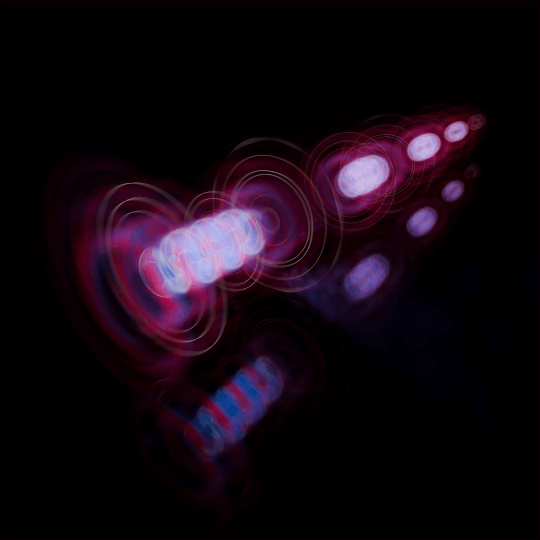
Illustration of the spatially structured self-imaging phenomenon known as the Montgomery effect. The color palette corresponds to the phase profile of the light, revealing the helical wavefront of light with orbital angular momentum, re-appearing over propagation. Image credit: Joshua Mornhinweg
<関連情報>
- https://seas.harvard.edu/news/focusing-and-defocusing-light-without-lens
- https://opg.optica.org/optica/fulltext.cfm?uri=optica-13-2-195
自由空間における空間構造化されたモンゴメリ効果の観測 Observation of the spatially structured Montgomery effect in free space
Murat Yessenov, Luca Sacchi, Alfonso Palmieri, Layton A. Hall, Ayman F. Abouraddy, and Federico Capasso
Optica Published: January 23, 2026
DOI:https://doi.org/10.1364/OPTICA.582198
Abstract
Talbot effect is a lens-less self-imaging phenomenon with a wide range of applications in optics. A lesser-known yet potentially more versatile Montgomery effect generalizes self-imaging to aperiodic structures. We report the first, to our knowledge, direct observation of the spatially structured Montgomery effect in free space. Using a dynamic optical hologram to discretize radial spatial frequencies, we demonstrate self-imaging at distances ranging from 30 to 100 mm. Our method independently controls the focal spot size and self-imaging period, enabling dynamic three-dimensional light patterns. We also show the arbitrary tunability of the transverse profile by demonstrating revivals of Laguerre–Gaussian, Hermite–Gaussian, Ince–Gaussian modes, and Airy beams. These findings open opportunities for multi-plane microscopy, optical atom traps, and quantum atomic systems.


