2026-01-29 ミュンヘン大学(LMU)
<関連情報>
- https://www.lmu.de/en/newsroom/news-overview/news/new-theory-for-exploration-of-exoplanets-ad523241.html
- https://iopscience.iop.org/article/10.3847/1538-4357/ae3246
太陽系外惑星大気の非等圧透過分光法に関する閉形式解析理論 A Closed-form Analytical Theory of Nonisobaric Transmission Spectroscopy for Exoplanet Atmospheres
Leonardos Gkouvelis
The Astrophysical Journal Published: 2026 January 29
DOI:10.3847/1538-4357/ae3246
Abstract
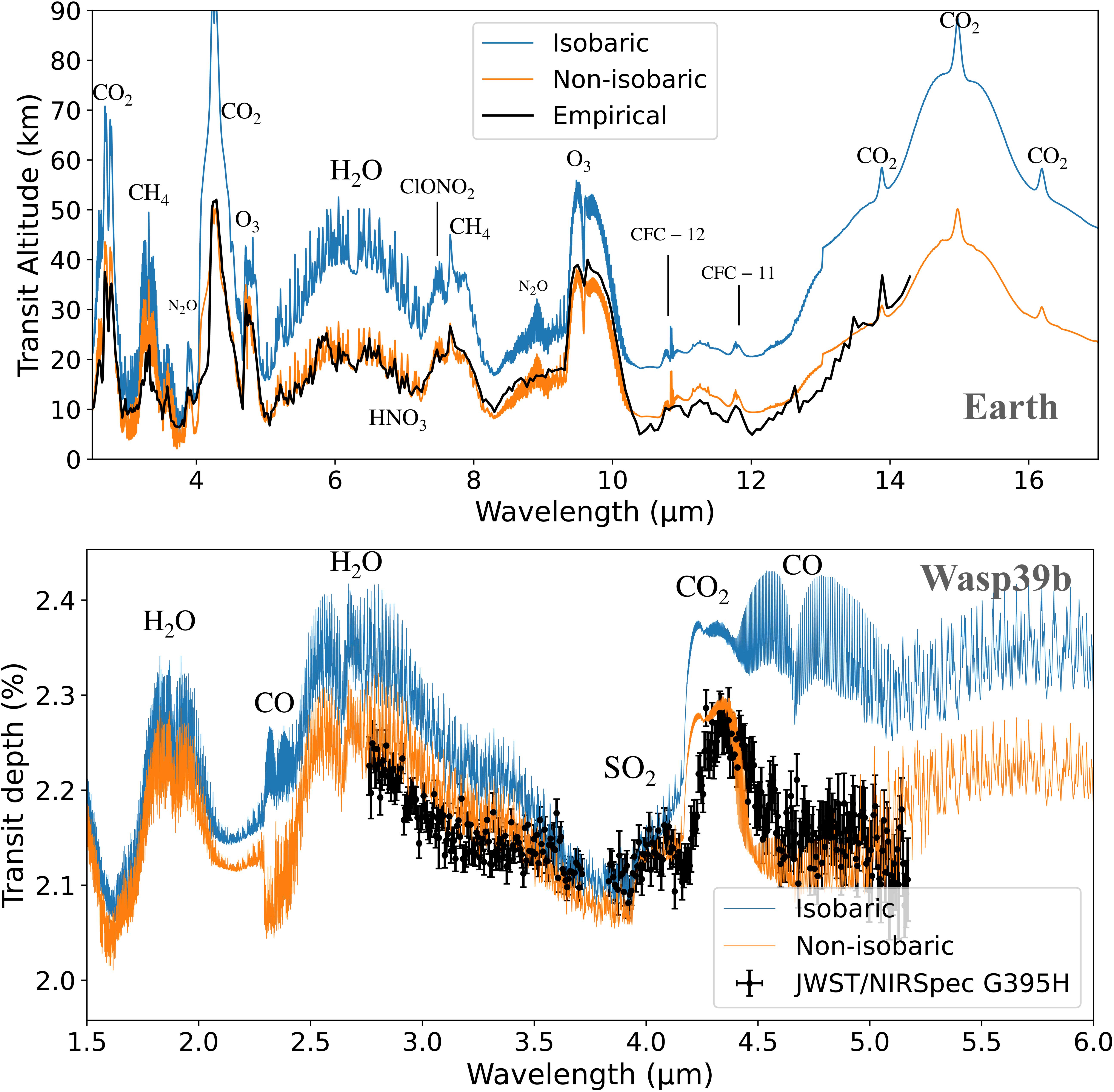
Analytical models are essential for building physical intuition and guiding the interpretation of exoplanet observations by clarifying the dependencies that shape atmospheric signatures. I present a generalization of the classical isothermal, isobaric transmission model by allowing the opacity to vary with pressure as a power law, κ ∝ Pn, and explicitly defining the reference opacity κ0 at a chosen pressure P0. By treating the slant optical depth as an Abel transform of the radial absorption coefficient, I derive a closed-form expression for the effective transit radius in a hydrostatic, isothermal atmosphere with pressure-dependent opacity. The solution provides a compact framework for exploring nonisobaric effects and explicitly links the vertical opacity gradient to observable spectral features. I benchmark the model against empirical transmission spectra of Earth and the hot Jupiter WASP-39b, finding a significantly improved fit relative to the isobaric formula. This generalized expression offers a physically interpretable foundation for analyzing high-precision spectra from JWST and upcoming ARIEL observations, and can serve as a basis for semianalytical retrieval approaches optimized for computational efficiency.