2026-01-29 ミュンヘン大学(LMU)
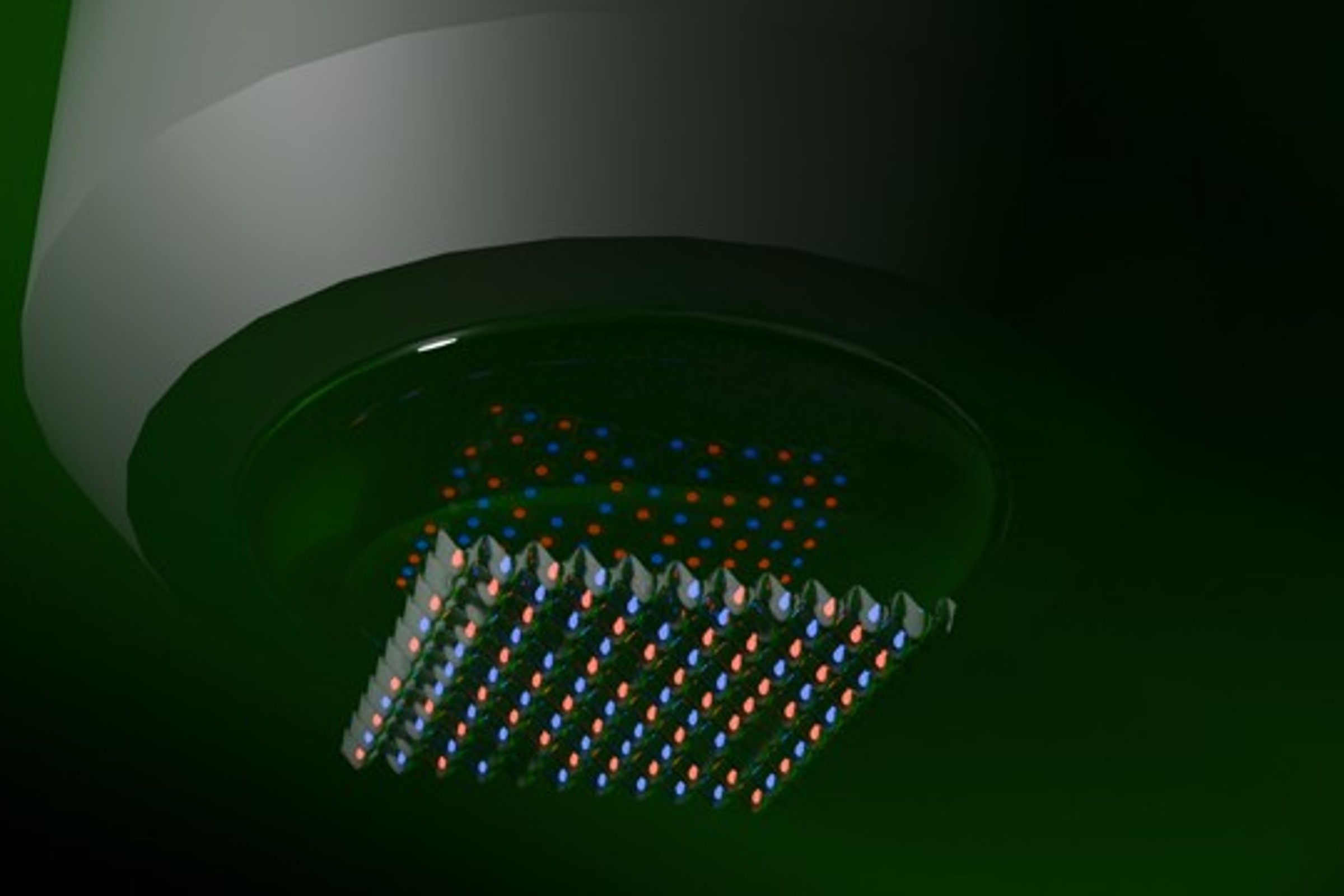
Illustration of the quantum gas microscope:This device enables researchers to image atoms in high resolution and visualize both their spatial position and their magnetic correlations. | © Titus Franz, MPQ
<関連情報>
- https://www.lmu.de/en/newsroom/news-overview/news/hidden-order-in-quantum-chaos-the-pseudogap-4bc241f6.html
- https://www.pnas.org/doi/10.1073/pnas.2525539123
擬ギャップ開始時のスピン-電荷相関の出現スケーリングの観測 Observation of emergent scaling of spin–charge correlations at the onset of the pseudogap
Thomas Chalopin, Petar Bojović, Si Wang, +11 , and Immanuel Bloch
Proceedings of the National Academy of Sciences Published:January 23, 2026
DOI:https://doi.org/10.1073/pnas.2525539123
Significance
Understanding strongly correlated fermions constitutes a major challenge of modern physics. Here, we take a significant step in this direction, by the finding of a universal scaling of spin and charge correlations upon entering the pseudogap phase in the paradigmatic Hubbard model, using our ultracold atom quantum simulator. This leads to a quantitative description of how doping suppresses the spin stiffness, concurrent with the emergence of dominant higher-order correlations that we observe in the system. Our characterization of the magnetic properties of the pseudogap in the paradigmatic Hubbard model paves the way for future studies of further collective phases of matter that the pseudogap is believed to give way to at even lower temperatures.
Abstract
In strongly correlated materials, interacting electrons are entangled and form collective quantum states, resulting in rich low-temperature phase diagrams. Notable examples include cuprate superconductors, in which superconductivity emerges at low doping out of an unusual “pseudogap” metallic state above the critical temperature. The Fermi–Hubbard model, describing a wide range of phenomena associated with strong electron correlations, still offers major computational challenges despite its simple formulation. In this context, ultracold atoms quantum simulators have provided invaluable insights into the microscopic nature of correlated quantum states. Here, we use a quantum gas microscope Fermi–Hubbard simulator to explore a wide range of dopings and temperatures in a regime where a pseudogap is known to develop. By measuring multipoint correlation functions up to fifth order, we uncover a universal scaling behavior in magnetic and higher-order spin–charge correlations characterized by a doping-dependent temperature scale. Accurate comparisons with determinant Quantum Monte Carlo and Minimally Entangled Typical Thermal States simulations confirm that this temperature scale is comparable to the pseudogap temperature . Our quantitative findings reveal a qualitative behavior of magnetic properties and spin–charge correlations in an emergent pseudogap and pave the way toward the exploration of charge pairing and collective phenomena expected at lower temperatures.