2026-01-28 中国科学院(CAS)
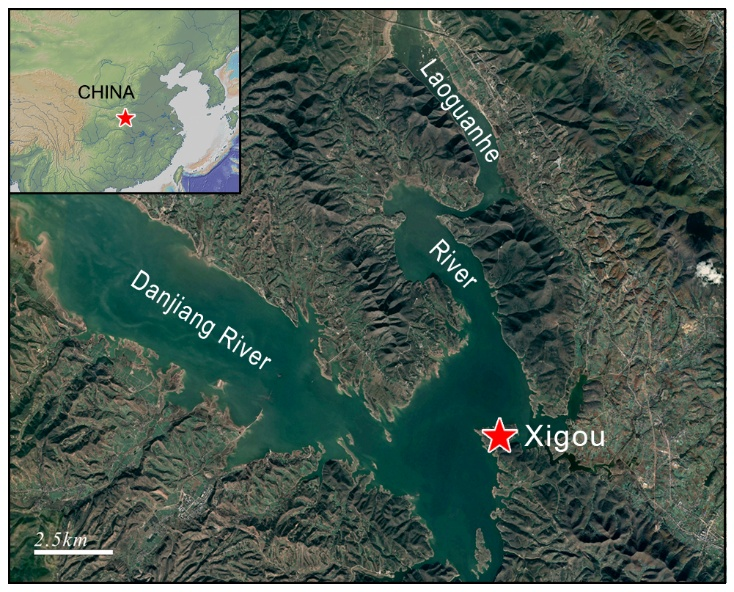
Location of the Xigou site. (Image by IVPP)
<関連情報>
- https://english.cas.cn/newsroom/research-news/202602/t20260210_1150365.shtml
- https://www.nature.com/articles/s41467-025-67601-y
中国中部における技術革新と柄付き武器の技術(約16万~7万2000年前) Technological innovations and hafted technology in central China ~160,000–72,000 years ago
Jian-Ping Yue,Guo-Ding Song,Shi-Xia Yang,Shu-Gang Kang,Jing-Ya Li,Ben Marwick,Andreu Ollé,Juan Luis Fernández-Marchena,Pei-Xian Shu,Hao-Yu Liu,Yu-Xiu Zhang,Fa-Xiang Huan,Qing-Po Zhao,Bao-Tong Qiao,Zhong-Shan Shen,Cheng-Long Deng & Michael Petraglia
Nature Communications Published:27 January 2026
DOI:https://doi.org/10.1038/s41467-025-67601-y
Abstract
Technological innovations in Africa and western Europe in the later part of the Middle Pleistocene signal the behavioural complexity of hominin populations. Yet, at the same time, it has long been believed that hominin technologies in Eastern Asia lack signs of innovation and sophistication. Here, we report on technological innovations occurring at Xigou, in the Danjiangkou Reservoir Region, central China, dating to ~160,000–72,000 years ago. Technological, typological, and functional analyses reveal the presence of advanced technological behaviours spanning over a 90,000-year period. The Xigou hominins used core-on-flake and discoid methods to effectively obtain small dimensional flakes to manufacture a diverse range of tool forms. The identification of the hafted tools provides the earliest evidence for composite tools in Eastern Asia, to our knowledge. Technological innovations revealed at Xigou and other contemporary sites in China correspond with increasing evidence for Late Quaternary hominin morphological variability, including larger brain sizes, such as demonstrated at Lingjing (Xuchang) in central China. The complex technological advancements recorded at Xigou indicate that hominins developed adaptive strategies that enhanced their survivability across fluctuating environments of the late Middle Pleistocene and middle Late Pleistocene in Eastern Asia.