2026-01-26 中国科学院(CAS)
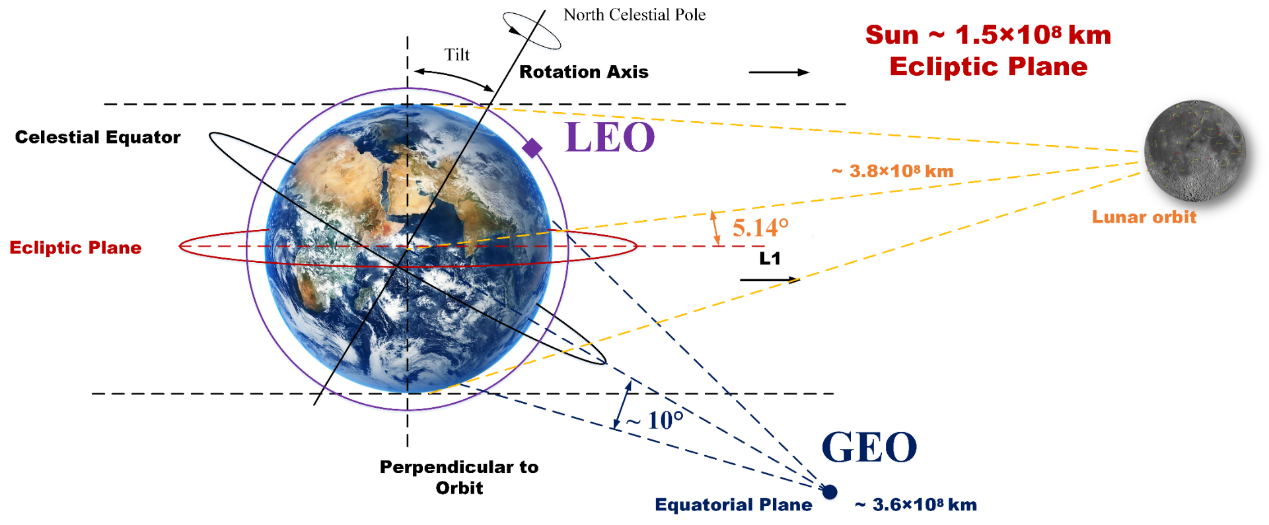
Diagram comparing ultra-long-range, low-Earth orbit, and geostationary satellite observation systems. (Image by YE Hanlin)
<関連情報>
- https://english.cas.cn/newsroom/research-news/202602/t20260210_1150360.shtml
- https://agupubs.onlinelibrary.wiley.com/doi/10.1029/2025JD044758
球面調和関数の指紋は、月ベースの円盤積分地球放射シグネチャを特徴づける Spherical Harmonic Fingerprints Characterize Moon-Based Disk-Integrated Earth’s Emitted Radiation Signatures
Hanlin Ye, Huadong Guo, Dong Liang, Mengxiong Zhou, Yin Jin, Guang Liu
Journal of Geophysical Research: Atmospheres Published: 31 December 2025
DOI:https://doi.org/10.1029/2025JD044758
Abstract
A Moon-based radiometer enables disk-integrated measurements to capture planetary-scale variations in Earth’s emitted radiation. However, existing studies have neither unraveled the influence of orbital dynamics on such radiation nor quantified how clouds modify these periodic signatures at the planetary scale, which leaves the underlying mechanisms driving disk-integrated radiation variations obscure and makes it difficult to isolate the authentic signals of the planetary system. In this study, outputs from NASA’s Goddard Earth Observing System Version 5 (GEOS-5) model were mapped onto the Moon-based Earth observation geometry to simulate time-series data of disk-integrated radiation. The variability characteristics of this radiation were quantified via spherical harmonic decomposition, and the constructed spherical harmonic fingerprints effectively separate orbital dynamics and radiation signatures in disk-integrated observations. Results show that (a) Moon-based disk-integrated radiation variations are dominated by 1st- and 2nd-degree spherical harmonics, capturing large-scale radiative features while smoothing fine-scale fluctuations; (b) key cycles driven by Earth-Moon geometry include the synodic month, the sidereal month, and their semiperiodic counterparts, which are primarily governed by sectoral and zonal harmonic components, respectively; (c) clouds systematically reduce disk-integrated radiation but preserve orbital-driven periodicities, which averages out local cloud effects while retaining celestial motion signals. This study further discussed the potential of these observations to refine general circulation models (GCMs) via planetary-scale reality checks, as well as of bridging Earth system science and astrophysics by using Earth as a sample. In general, this study lays a foundation for interpreting disk-integrated radiation features in future missions.