2026-01-26 オックスフォード大学
<関連情報>
- https://www.ox.ac.uk/news/2026-01-26-global-population-living-extreme-heat-double-2050
- https://www.nature.com/articles/s41893-025-01754-y
気候変動シナリオにおける暖房度日と冷房度日のグローバルグリッドデータセット Global gridded dataset of heating and cooling degree days under climate change scenarios
Jesus Lizana,Nicole D. Miranda,Sarah N. Sparrow,David C. H. Wallom,Radhika Khosla &Malcolm McCulloch
Nature Sustainability Published:26 January 2026
DOI:https://doi.org/10.1038/s41893-025-01754-y
Abstract
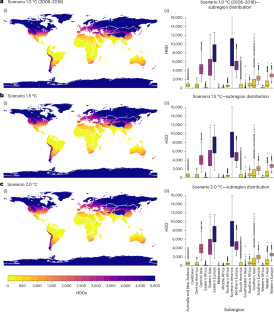
Accurate projections of heating and cooling demands are crucial for advancing towards the sustainable development goals. Here we present a global dataset of heating degree days (HDDs) and cooling degree days (CDDs) for 3 levels of global mean temperature rise above pre-industrial conditions—1.0 °C (2006–2016), 1.5 °C and 2.0 °C—regardless of the pathways leading to these warming scenarios. The dataset comprises 30 gridded maps (0.883° × 0.556° resolution) characterizing climate variability through 5 statistical metrics per variable and scenario over a representative 10-year period. The dataset reveals a widespread decline in HDDs and a pronounced, nonlinear increase in CDDs, with the most significant shifts in climate intensity and adaptation needs emerging early in the warming trajectory. Furthermore, using the ‘middle-of-the-road’ Shared Socioeconomic Pathway 2-4.5 as a reference, the dataset indicates that the population experiencing extreme heat conditions (exceeding 3,000 CDDs) is projected to nearly double if the 2.0 °C threshold is reached, increasing from 23% (1.54 billion people) in 2010 to 41% (3.79 billion) by 2050, with the largest projected populations affected in India, Nigeria, Indonesia, Bangladesh, Pakistan and the Philippines. This HDD–CDD dataset provides a robust foundation for integrating climate information into sustainability planning and development policy.