2026-01-22 中国科学院(CAS)
<関連情報>
- https://english.cas.cn/newsroom/headlines/202601/t20260122_1146341.shtml
- https://www.nature.com/articles/s41586-025-10013-1
溶解時の極端な圧力熱量効果 Extreme barocaloric effect at dissolution
Kun Zhang,Yifang Liu,Ying Gao,Zhe Zhang,Haoyu Wang,Wanwu Li,Xiaoyan Fan,Jiayu Ding,Ziqi Guan,Shogo Kawaguchi,Zhaoxu Du,Jiaqing Zhang,Lei Su,Yiming Li,Runjian Jiang,Yifan Li,Yating Jia,Yanxu Wang,Jianchao Lin,Jinlong Zhu,Peng Tong,Suxin Qian,Kuo Li,Zhidong Zhang & Bing Li
Nature Published:21 January 2026
DOI:https://doi.org/10.1038/s41586-025-10013-1
Abstract
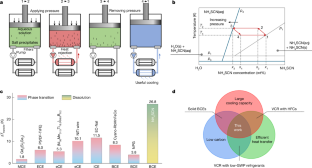
Refrigeration is indispensable to modern society1, yet the dominant vapour-compression systems rely on environmentally harmful fluorocarbon refrigerants with high global warming potential2,3,4. Solid-state caloric refrigeration offers a low-carbon alternative5,6,7, but its practical deployment has been hindered by limited cooling capacity and the inefficient indirect heat transfer that requires secondary fluids. Here we report an extreme barocaloric effect in NH4SCN aqueous solutions enabled by pressure-tuned dissolution and precipitation. This mechanism delivers an exceptionally large cooling capacity and markedly enhanced cooling efficiency. We obtain an in situ temperature drop of 26.8 K in the solution at room temperature, surpassing all known caloric materials. A Carnot-like cycle is designed to deliver 67 J g−1 cooling capacity per cycle with a second-law efficiency of 77%, benefiting from the extremely large temperature drops and direct heat transfer due to the self-circulating aqueous solution. Beyond the phase-transition scenario, this dissolution-based approach that combines the merits of current leading technologies emerges as a promising sustainable refrigeration solution.