2026-01-22 スイス連邦材料試験研究所(EMPA)
<関連情報>
- https://www.empa.ch/web/s604/hymetbat
- https://link.springer.com/article/10.1557/s43580-025-01397-3
- https://www.mdpi.com/2073-4352/15/10/841
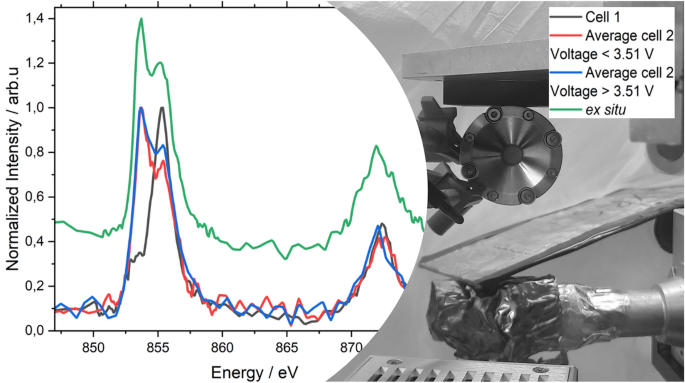
LiNix Mny Co1-xyO 2リチウムイオン電池電極のOperando X線ラマンNi 2pスペクトル Operando X-ray Raman Ni 2p spectra of LiNixMnyCo1-x-yO2 lithium-ion battery electrodes
Adrian Jonas,Selma Erat,Nikolay Ryzhkov,Alexey Rulev,Katja Frenzel,Hongxin Wang,Glennise Faye C. Mejica,Jan Goran T. Tomacruz,Oscar Paredes,Dimosthenis Sokaras,Burkhard Beckhoff & Artur Braun
MRS Advances Published:25 September 2025
DOI:https://doi.org/10.1557/s43580-025-01397-3
Abstract
Lithium manganese nickel oxides are a prominent class of materials used for positively charged lithium-ion batteries. Three different archetype stoichiometries of lithium nickel manganese cobalt oxides (NMC) were studied with bulk-sensitive X-ray Raman and surface-sensitive soft X-ray absorption spectroscopy. We have conducted complementary operando battery X-ray experiments on the NMC622 electrode over one full charge and discharge cycle in a specifically designed operando battery cell. The ex situ NEXAFS spectra of the Ni L-edges show distinct differences in their multiplet characteristics depending on the cathode composition. The obtained operando X-ray Raman spectra show changes in the branching ratio of the Ni 2p spectra and confirms that the state of charge of the battery correlates with changes in the bulk of the electrode.
Graphical abstract
57 Fe Phonon DOS を搭載したLiFePO 4バッテリーのOperando NRVS Operando NRVS on LiFePO4 Battery with 57Fe Phonon DOS
Alexey Rulev,Nobumoto Nagasawa,Haobo Li,Hongxin Wang,Stephen P. Cramer,Qianli Chen,Yoshitaka Yoda and Artur Braun
Crystals Published: 27 September 2025
DOI:https://doi.org/10.3390/cryst15100841
Abstract
The vibration properties of materials play a role in their conduction of electric charges. Ionic conductors such as electrodes and solid electrolytes are also relevant in this respect. The vibration properties are typically assessed with infrared and Raman spectroscopy, and inelastic neutron scattering, which all allow for the derivation of the phonon density of states (PDOS) in part of a full portion of the Brioullin zone. Nuclear resonant vibration spectroscopy (NRVS) is a novel method that produces the element-specific PDOS from Mössbauer-active isotopes in a compound. We employed NRVS operando on a pouch cell battery containing a Li57FePO4 electrode, and thus could derive the PDOS of the 57Fe in the electrode during charging and discharging. The spectra reveal reversible vibrational changes associated with the two-phase conversion between LiFePO4 and FePO4, as well as signatures of metastable intermediate states. We demonstrate how the NRVS data can be used to tune the atomistic simulations to accurately reconstruct the full vibration structures of the battery materials in operando conditions. Unlike optical techniques, NRVS provides bulk-sensitive, element-specific access to the full phonon spectrum under realistic operando conditions. These results establish NRVS as a powerful method to probe lattice dynamics in working batteries and to advance the understanding of ion transport and phase transformation mechanisms in electrode materials.