2026-01-19 中国科学院(CAS)
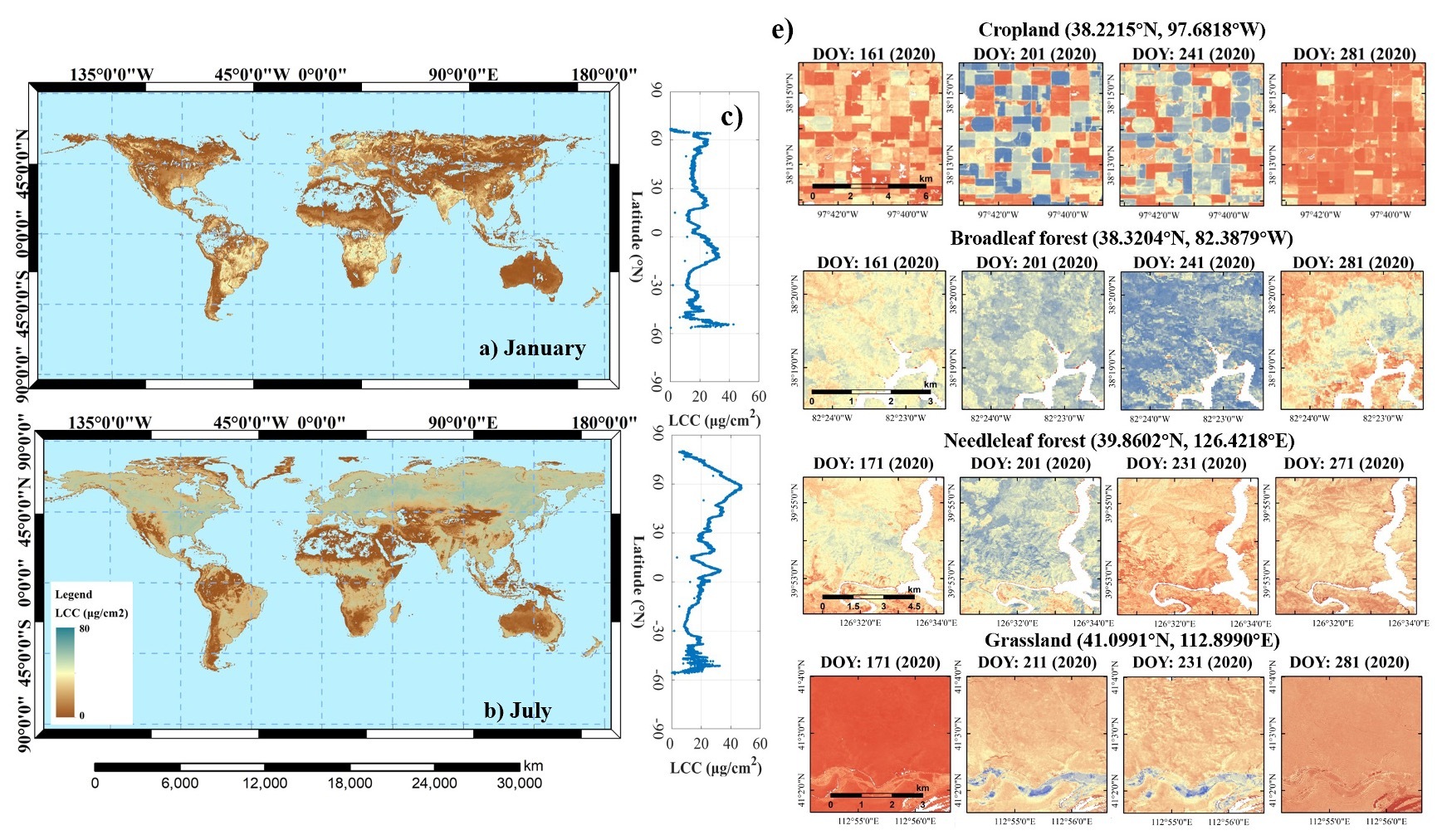
Global distribution of the MuSyQ Global LCC product. Mean LCC in January 2020 (a) and July 2020 (b). Latitudinal averages of chlorophyll (c,d). Seasonal variations at representative sites for different vegetation types in 2020 (e). (Image by AIRCAS)
<関連情報>
- https://english.cas.cn/newsroom/research-news/202602/t20260210_1150347.shtml
- https://www.nature.com/articles/s41597-025-05831-x
Sentinel-2データを使用した高解像度の全球葉クロロフィル含有量製品 A high-resolution global leaf chlorophyll content product using the Sentinel-2 data
Hu Zhang,Jing Li,Chenpeng Gu,Li Guan,Xiaohan Wang,Faisal Mumtaz,Yadong Dong,Jing Zhao,Qinhuo Liu,Shangrong Lin & Wentao Yu
Scientific Data Published:24 December 2025
DOI:https://doi.org/10.1038/s41597-025-05831-x
Abstract
Leaf chlorophyll content (LCC) serves as a critical indicator for quantifying photosynthetic carbon assimilation, providing fundamental data for terrestrial carbon cycle estimation. In the past five years, some global LCC remote sensing products have been generated, but their resolution ranges from 300 m to 500 m. This study employed an empirical relationship method based on the Chlorophyll Sensitive Index (CSI) to produce the Multi-source data Synergized Quantitative Global LCC product (MuSyQ Global LCC) with a resolution from 100 m to 10 m using the Google Earth Engine (GEE) platform. Validation results demonstrate that the 10m-resolution MuSyQ Global LCC product has an RMSE of 13.69 μg/cm2, R2 of 0.37, and the RMSE is between 11.28 μg/cm2 and 15.22 μg/cm2 for different vegetation types. Its finer resolution reveals more spatial details compared with the existing global products. When upscaled to 500 m, it demonstrates high consistency with the MODIS LCC product, and MuSyQ Global LCC (RMSE = 14.16 μg/cm2) exhibits higher accuracy than MODIS LCC (RMSE = 14.74 μg/cm2).