2026-01-16 東京科学大学
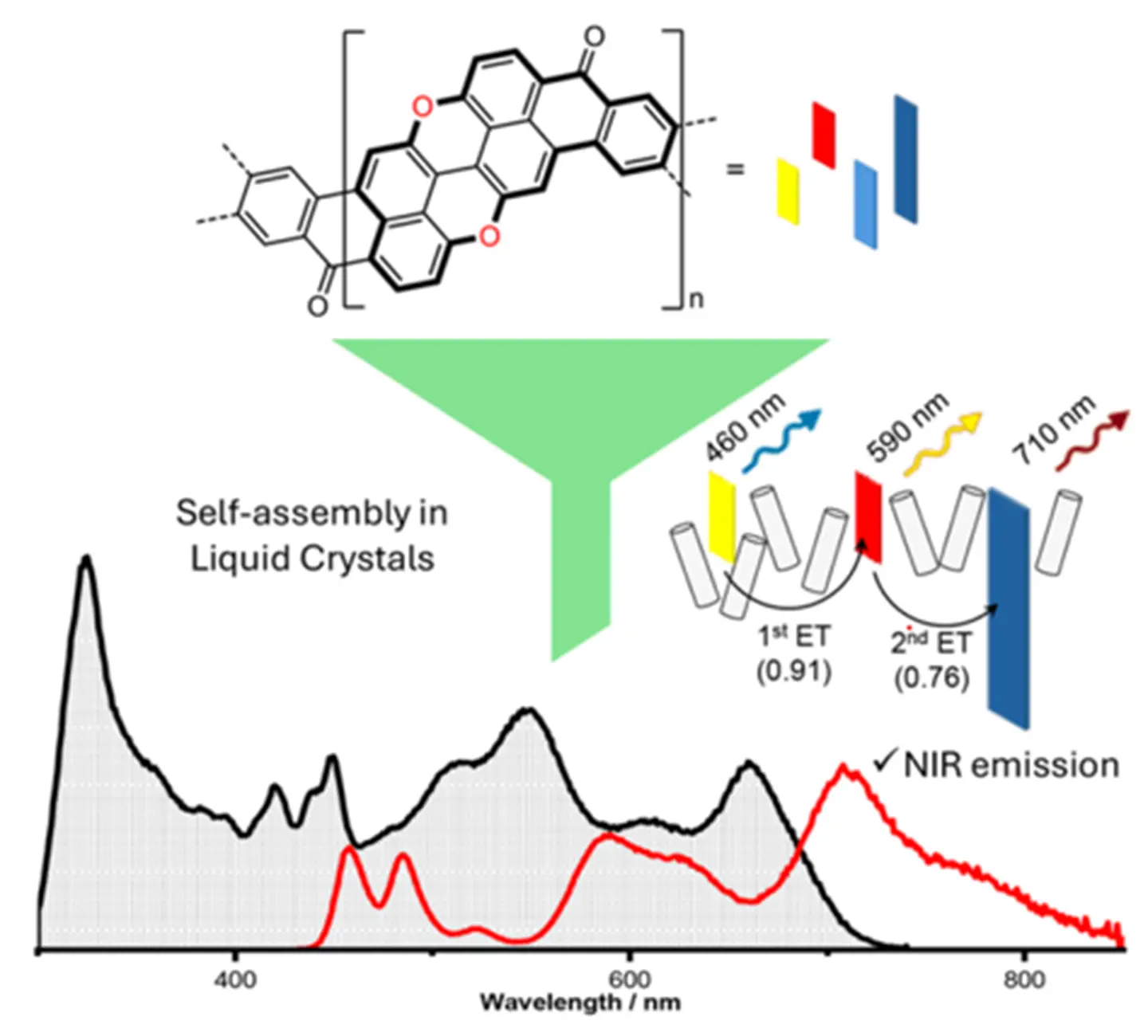
PXXナノリボンとネマチック液晶を用いた人工LHS
<関連情報>
- https://www.isct.ac.jp/ja/news/h307iurzbmmf
- https://onlinelibrary.wiley.com/doi/10.1002/anie.202523349
ベンゾイル-キサンテノキサンテン:多彩な発色団の光捕集への応用Benzoyl-Xanthenoxanthenes: Versatile Chromophores for Light-Engaging Applications
Dr. Cristian De Luca, El Czar Galleposo, Rúben R. Ferreira, Chiara Puccinelli, Prof. Mag. Dr. Herwig Peterlik, Dr. Pradip Kumar Mondal, Laurens van Dam, Dr. Johannes C. B. Dietschreit, Yoshimichi Shimomura, Prof. Dr. Gen-ichi Konishi, Prof. Dr. Davide Bonifazi …
Angewandte Chemie International Edition Published: 09 January 2026
DOI:https://doi.org/10.1002/anie.202523349
Abstract
In this work, we present a modular donor–acceptor strategy that produces oxidatively stable, benzoyl-fused peri-xanthenoxanthene (PXX) ribbons with near-infrared (NIR) emission and light-harvesting properties. Benzoyl fusion at the pseudo-peri positions, achieved through intramolecular Friedel–Crafts planarization, creates the first benzoyl-functionalized PXX monomers, dimers, and trimers that exhibit deep red–NIR absorption and emission without significantly raising the HOMO level. The ribbons display strong, tunable absorption and fluorescence bands, with up to 63% of emission in the NIR and an NIR fluorescence quantum yield reaching 0.36 in solution. Lewis adducts formed between boron-based Lewis acids and carbonyl acceptor sites further enhance the electron-accepting nature of the ketones, producing pure NIR emission ( ≈ 0.15–0.16). Spectroelectrochemical investigations uncover reversible electrochromism and electrofluorochromism, allowing redox-gated switching and NIR absorption signatures, useful for sensing and display technologies. When embedded in a nematic liquid crystal phase, the ribbons function as cascaded Förster resonance energy transfer (FRET) antennas, achieving near-quantitative single-step energy transfer (
 FRET = 0.97) and highly efficient two-step transfer (
 FRET = 0.70), enabling directional energy funneling. Their complementary absorption broadens the excitation window to cover the entire visible spectrum, making them highly efficient panchromatic light-harvesting materials.