2026-01-13 自然科学研究機構
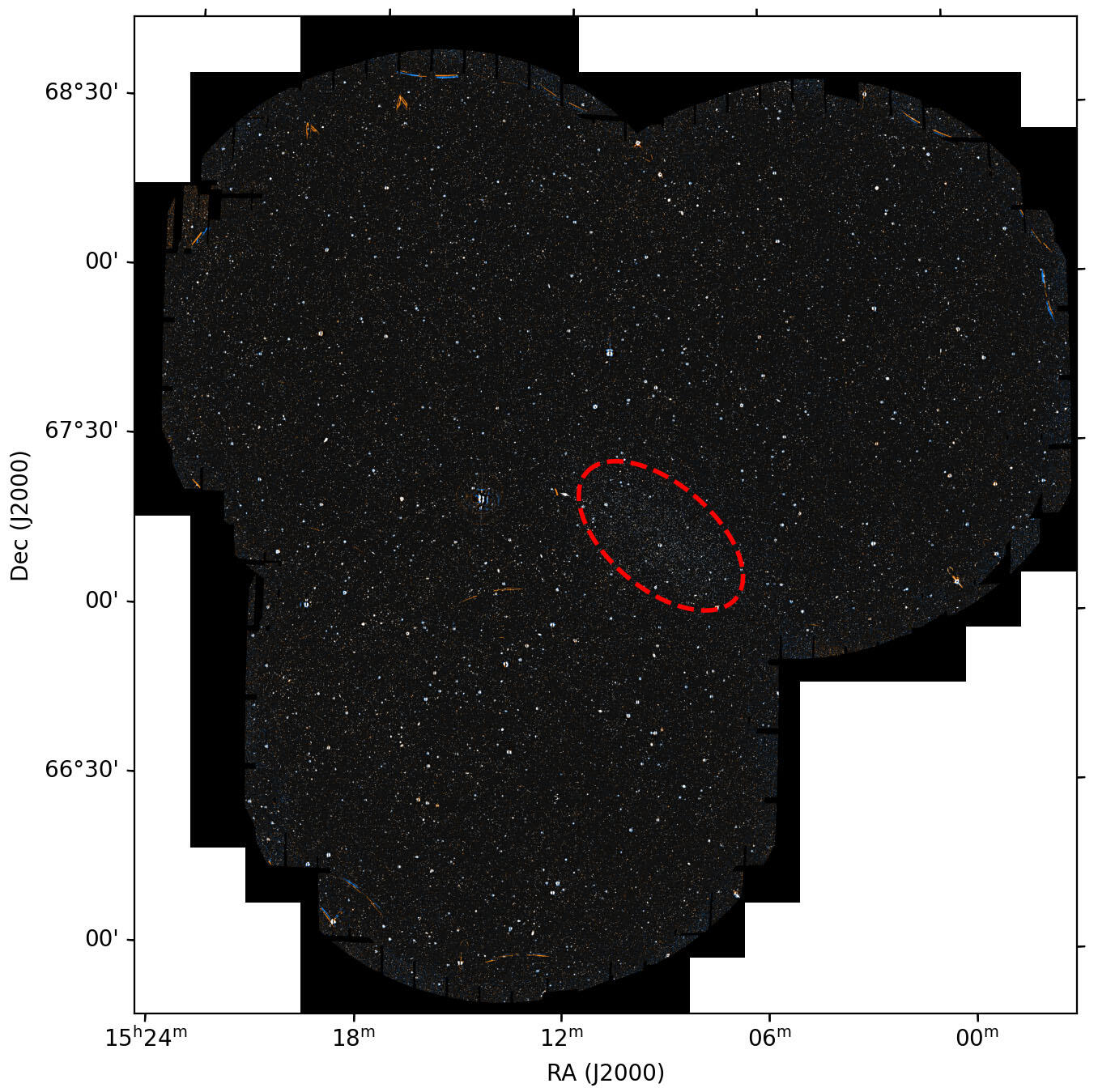
図1:Hyper Suprime-Cam で観測したこぐま座矮小銀河の天体画像(3視野分)。楕円は矮小銀河の中心部を示しています。非常に淡い天体のため目視での判別は難しいものの、画像の端までこぐま座矮小銀河の星が広がっています。(クレジット:国立天文台)
<関連情報>
- https://subarutelescope.org/jp/results/2026/01/13/3640.html
- https://iopscience.iop.org/article/10.3847/2041-8213/ae0cb3
こぐま座矮小楕円銀河の外縁部における拡張された恒星分布 The Extended Stellar Distribution in the Outskirts of the Ursa Minor Dwarf Spheroidal Galaxy
Kyosuke S. Sato, Sakurako Okamoto, Masafumi Yagi, Yutaka Komiyama, Nobuo Arimoto, Rosemary F.G. Wyse, Evan N. Kirby, Masashi Chiba, Itsuki Ogami, and Mikito Tanaka
The Astrophysical Journal Letters Published: 2025 October 23
DOI:10.3847/2041-8213/ae0cb3
Abstract
We discover an extended distribution of main-sequence (MS) stars along the minor axis of the Ursa Minor (UMi) dwarf spheroidal galaxy (dSph). This study is enabled by deep, wide Subaru/Hyper Suprime-Cam data, reaching photometric uncertainties below 0.1 mag at g, i ∼ 26 mag. Color–magnitude diagrams along the major and minor axes reveal a clear excess of MS stars beyond the nominal tidal radius along the minor axis. To characterize this structure, we derive radial number density profiles in seven azimuthal directions and fit them with an exponential+power-law function to assess the symmetry of the extended component. The power-law slopes tend to be shallower toward the minor axis, though the symmetry remains inconclusive within 1σ uncertainties. This may indicate that the extended component is preferentially distributed along the minor axis and could be different from the previously suggested tidal features along the major axis. Comparing with simulations, we find that the fraction of stars beyond five effective radii is consistent with expectations from an intermediate mass ratio merger scenario with a stellar mass ratio around 6:1. While these findings provide new insights into the structural complexity and dynamical history of the UMi dSph, alternative mechanisms such as stellar or supernova feedback have also been proposed for extended stellar halos in dwarfs and cannot be ruled out.