2026-01-15 中国科学院(CAS)
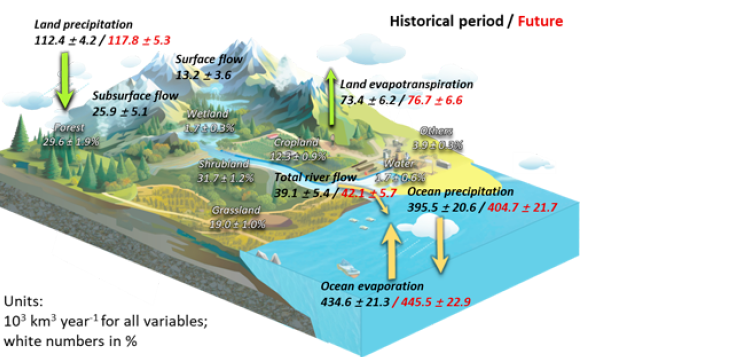
Partitioning of the global water cycle using the Emergent Constraint approach. (Image by Prof. ZHANG Yongqiang’s team)
<関連情報>
- http://english.igsnrr.cas.cn/newsroom/topnews/202601/t20260109_1145545.html
- https://www.nature.com/articles/s41561-025-01897-9
地球システムモデルによる世界の河川流量の過去および将来の増加の過大評価 Overestimation of past and future increases in global river flow by Earth system models
Yongqiang Zhang,Günter Blöschl,Haoshan Wei,Dongdong Kong,Ning Ma,Thorsten Wagener,Jing Tian,Jun Xia,Congcong Li,Longhao Wang,Francis H. S. Chiew,L. Ruby Leung,Xingcai Liu,Hongxing Zheng,Xuanze Zhang & Changming Liu
Nature Geoscience Published:09 January 2026
DOI:https://doi.org/10.1038/s41561-025-01897-9
Abstract
Reliable quantification of global water-cycle components, such as river flow and land evapotranspiration, remains a major challenge. Here we refine estimates of global water partitioning by combining outputs from multiple Earth system models with river flow observations from 50 large basins, applying the emergent constraint approach. Between 1980 and 2014, global river flow was (39.1 ± 5.4) × 103 km3 yr−1, with a river flow-to-precipitation ratio of 0.35 ± 0.03, both lower than previous estimates. Land evapotranspiration reached (73.4 ± 6.2) × 103 km3 yr−1. Under climate change, we project global river flow to rise by 7.8 ± 5.5 mm per year per degree of warming. This estimate, refined through the emergent constraint method, is 9.3% lower than the ensemble mean of Earth system models and reduces inter-model uncertainty by 66%. By integrating river flow observations, we provide more accurate historical estimates and strengthen future projections of global water-cycle components.