2026-01-14 コペンハーゲン大学(UCPH)
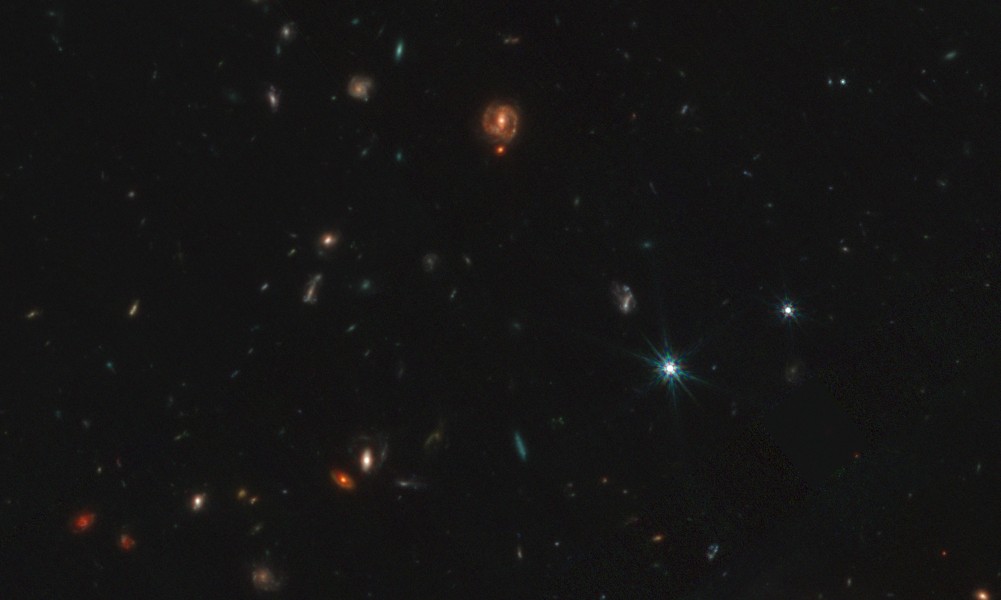
The little red dots are young black holes, enshrouded in a cocoon of gas, which they are consuming in order to grow larger. This process generates enormous heat which gives little red dots their unique red colour. Photo: JWST/Darach Watson
<関連情報>
- https://news.ku.dk/all_news/2026/01/copenhagen-researchers-make-the-front-page-of-nature-solving-the-mystery-of-the-universes-little-red-dots/
- https://www.nature.com/articles/s41586-025-09900-4
高密度のイオン化された繭の中にある若い超大質量ブラックホールとしての小さな赤い点 Little red dots as young supermassive black holes in dense ionized cocoons
V. Rusakov,D. Watson,G. P. Nikopoulos,G. Brammer,R. Gottumukkala,T. Harvey,K. E. Heintz,R. Damgaard,S. A. Sim,A. Sneppen,A. P. Vijayan,N. Adams,D. Austin,C. J. Conselice,C. M. Goolsby,S. Toft & J. Witstok
Nature Published:14 January 2026
DOI:https://doi.org/10.1038/s41586-025-09900-4
Abstract
The James Webb Space Telescope (JWST) has uncovered many compact galaxies at high redshift with broad hydrogen and helium lines, including the enigmatic population of little red dots (LRDs)1,2. The nature of these galaxies is debated and is attributed to supermassive black holes (SMBHs)3,4 or intense star formation5. They exhibit unusual properties for SMBHs, such as black holes that are overmassive for their host galaxies4 and extremely weak X-ray6,7,8,9,10 and radio6,11,12,13 emission. Here we show that in most objects studied with the highest-quality JWST spectra, the lines are broadened by electron scattering with a narrow intrinsic core. The data require very high electron column densities and compact sizes (light days), which, when coupled with their high luminosities, can be explained only by SMBH accretion. The narrow intrinsic line cores imply black hole masses of 105−7M⊙, two orders of magnitude lower than previous estimates. These are the lowest mass black holes known at high redshift, to our knowledge, and suggest a population of young SMBHs. They are enshrouded in a dense cocoon of ionized gas producing broad lines from which they are accreting close to the Eddington limit, with very mild neutral outflows. Reprocessed nebular emission from this cocoon dominates the optical spectrum, explaining most LRD spectral characteristics, including the weak radio and X-ray emission14,15.