2026-01-14 中国科学院(CAS)
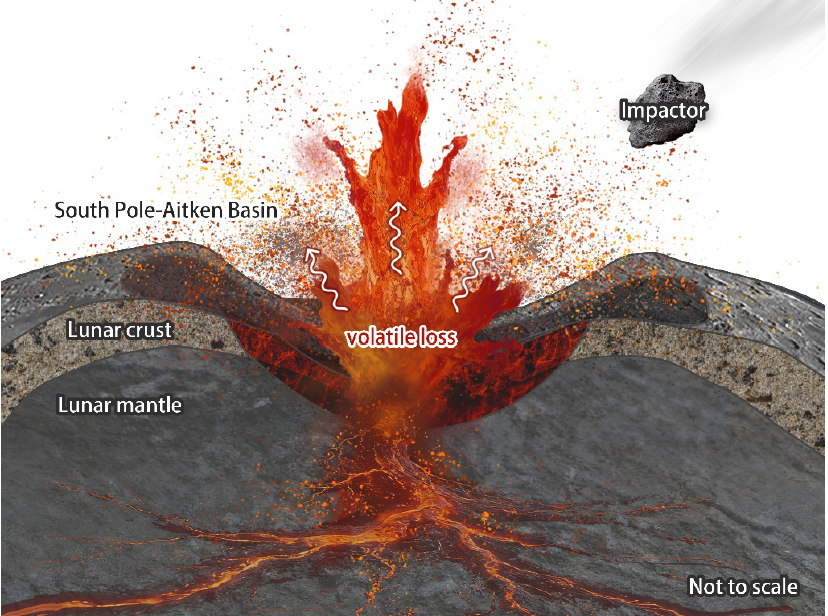 Schematic illustration of how the SPA basin-forming impact modified the lunar crust and mantle and led to volatile loss during the event. (Image by Prof. TIAN Hengci)
<関連情報>
- http://english.igg.cas.cn/rh/rp/202601/t20260112_1145613.html
- https://www.pnas.org/doi/10.1073/pnas.2515408123
南極エイトケン盆地形成の衝突による揮発性物質の消失の同位体証拠 Isotopic evidence for volatile loss driven by South Pole-Aitken basin–forming impact
Heng-Ci Tian, Chi Zhang, Wen-Jun Li, +6 , and Fu-Yuan Wu
Proceedings of the National Academy of Sciences Published:January 12, 2026
DOI:https://doi.org/10.1073/pnas.2515408123
Significance
Chang’e-6 samples from the lunar farside could help resolve the origin of lunar asymmetry. High-precision isotopic analyses reveal that Chang’e-6 basalts are isotopically heavier in Fe and K than those from Apollo and Chang’e-5 missions. These heavy isotopic enrichments cannot be solely attributed to cosmogenic effects or impactor contributions. Although magmatic processes can explain the Fe isotopic data, the K isotopes necessitate a mantle source with a heavier K isotopic composition on the farside than on the nearside. This feature most likely resulted from K evaporation caused by the SPA basin–forming impact, demonstrating the profound influence of this event on the Moon’s deep interior. This finding also implies that large-scale impacts are key drivers in shaping mantle and crustal compositions.
Abstract
Recent studies suggest that the lunar farside experienced a magma ocean evolution similar to that of the nearside. Thus, the nearside-farside dichotomy, such as volcanism and crustal thickness, is likely related to the South Pole-Aitken (SPA) basin–forming impact. Although the noritic clasts found in Chang’e-6 (CE6) samples may originate from crustal remelting induced by the SPA impact, how (and whether) the lunar mantle was modified by this event remains unclear. Here, we present the first high-precision iron (Fe) and potassium (K) isotopic measurements of CE6 low-Ti basalts, revealing higher δ56Fe (0.13 to 0.21‰) and δ41K (0 to 0.09‰) in these basalts compared to their Apollo and Chang’e-5 (CE5) counterparts (δ56Fe: 0 to 0.11‰; δ41K: −0.29 to −0.04‰). The heavy Fe and K isotopic signatures are unlikely to be derived from cosmogenic effects or the addition of impactor-derived materials. Instead, the heavy Fe isotopes can be explained by partial melting and fractional crystallization processes. For K isotopes, however, the data require that the mantle source beneath the SPA basin had a heavier K isotopic composition than that of the nearside mantle, most likely resulting from evaporation caused by the SPA-forming impact. Our results thus provide robust evidence for significant impact-induced modification of the lunar mantle and demonstrate that large-scale impacts may have played a key role in creating lunar asymmetry.