
2026-01-13 カリフォルニア大学サンタバーバラ校(UCSB)
<関連情報>
- https://news.ucsb.edu/2026/022326/scientists-create-system-tracking-underwater-blackouts
- https://www.nature.com/articles/s43247-025-03023-4
水中照明の可用性が異常に低下する期間を評価するためのイベントベースのフレームワークとしての海洋ダークウェーブ Marine darkwave as an event-based framework to assess unusual periods of reduced underwater light availability
François Thoral,Matthew H. Pinkerton,Shinae Montie,Mads S. Thomsen,Christopher N. Battershill,Karen Filbee-Dexter,Mark Gall,Robert J. Miller,Shane Orchard,Daniel C. Reed,Leigh W. Tait,Spencer D. S. Virgin,Thomas Wernberg,John Zeldis & David R. Schiel
Communications Earth & Environment Published:12 January 2026
DOI:https://doi.org/10.1038/s43247-025-03023-4
Abstract
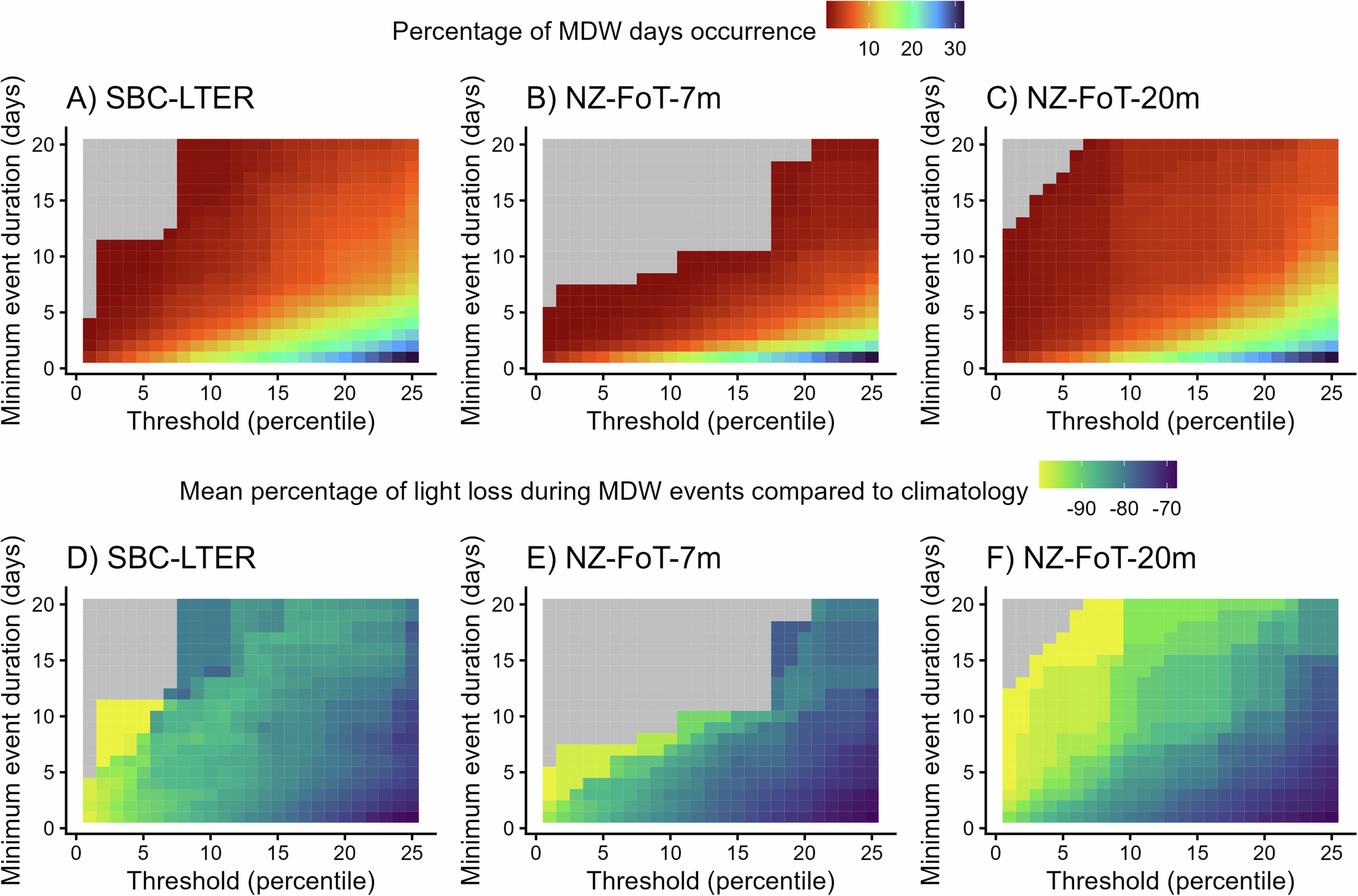
Episodic reductions in underwater light can be a key driver of marine ecosystem degradation. Yet a consistent event-based framework describing the frequency, duration and intensity of substantial but short-term reductions in underwater light does not exist. Here, we proposed marine darkwaves as a framework for quantifying these episodic reductions of underwater light at specific depths which aligns with definitions of other episodic and extreme events. The framework was applied to long-term in situ time series of underwater irradiance from California, USA (16 years, 6.3 metres) and New Zealand (10 years, at 7 and 20 metres). We showed evidence of several intense marine darkwaves across these sites, with durations up to 64 days, cumulative light deficits reaching −105.6 mol photon·m−2, and up to almost 100% light loss versus climatology. We extended the framework to satellite-derived seabed irradiance data across New Zealand’s East Cape region (2002–2023), using a set of 10th percentile threshold and a minimum duration of 5 days. This revealed 25 to 80 spatially varying seabed events, and event durations of 5 to 15 days. Importantly, the framework enables local to continental-scale comparisons of the patterns and ecological consequences of episodic light reduction in marine ecosystems.


