2026-01-12 ピッツバーグ大学
<関連情報>
- https://news.engineering.pitt.edu/putting-quantum-computing-to-the-test/
- https://journals.aps.org/prresearch/abstract/10.1103/ndc3-bdwt
移流拡散方程式の量子力学シミュレーション Quantum dynamics simulation of the advection-diffusion equation
Hirad Alipanah, Feng Zhang, Yong-Xin Yao, Richard Thompson, Nam Nguyen, Junyu Liu, Peyman Givi, Brian J. McDermott, and Juan José Mendoza-Arenas
Physical Review Research Published: 19 December, 2025
DOI: https://doi.org/10.1103/ndc3-bdwt
Abstract
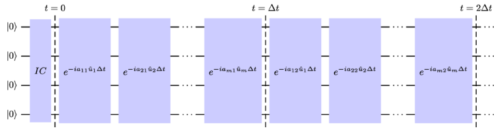
The advection-diffusion equation is simulated via several quantum algorithms. Three formulations are considered: (1) Trotterization, (2) variational quantum time evolution (VarQTE), and (3) adaptive variational quantum dynamics simulation (AVQDS). These schemes were originally developed for the Hamiltonian simulation of many-body quantum systems. The finite-difference discretized operator of the transport equation is formulated as a Hamiltonian and solved without the need for ancillary qubits. Computations are conducted on a quantum simulator (IBM Qiskit Aer) and a superconducting quantum hardware (IBM Fez). The former emulates the latter without the noise. The actual hardware implementation experiences significant noise. The results of the quantum simulator are compared with data from direct numerical simulation (DNS) with infidelities of the order 10−5. In the quantum simulator, Trotterization is observed to have the lowest infidelity and is suitable for fault-tolerant computation. The AVQDS algorithm requires the lowest gate count and circuit depth. The VarQTE algorithm is the next best in terms of gate counts, but the number of its optimization variables is directly proportional to the number of qubits. Due to current hardware limitations, Trotterization cannot be implemented, as it has an overwhelmingly large number of operations. Meanwhile, AVQDS and VarQTE can be executed at the hardware level. These algorithms present a new paradigm for computational transport phenomena on quantum computers.