2026-01-12 ミネソタ大学
<関連情報>
- https://cse.umn.edu/college/news/unleashing-floods-researchers-learn-more-about-how-fossils-form
- https://www.cambridge.org/core/journals/paleobiology/article/when-the-levee-breaks-experimentally-testing-dinosaur-and-mammal-bone-transport-in-unsteady-flows/7EABD0EB713023FA7F9B2194F58E89D6
堤防が決壊するとき:不安定な流れの中での恐竜と哺乳類の骨の輸送を実験的に検証する When the levee breaks: experimentally testing dinosaur and mammal bone transport in unsteady flows
Michael Chiappone,Michele Guala,Raymond Rogers and Peter Makovicky
Paleobiology Published:12 January 2026
DOI:https://doi.org/10.1017/pab.2025.10087
Abstract
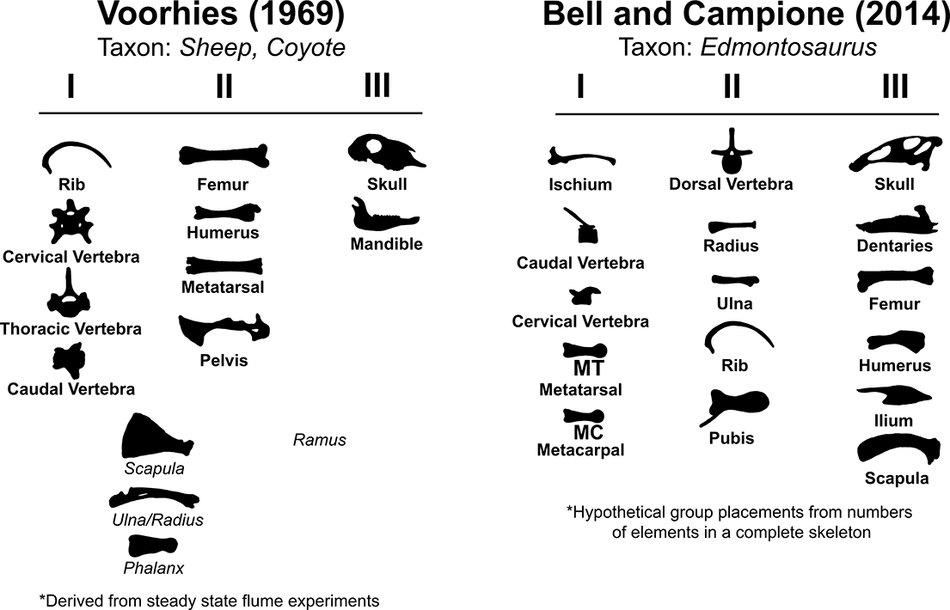
Bones preserved in fluvial sediments make up the majority of the terrestrial vertebrate fossil record, and unsteady flows (overbank floods, levee breaches, debris flows, etc.) are often invoked as agents of bone transport and burial. Experiments exploring transport of mammal bones under steady-state flow led to the development of Voorhies Groups, which are used as indicators of winnowing and transport at fossil sites. Some studies have raised concerns about the use of transport groups beyond the scope of the original experiments, especially regarding untested taxa and flow conditions. Here we investigate transport of hadrosauroid dinosaur bone models and modern sheep bones in experimental sheet floods. We find that evolving flow dynamics in unsteady flows can influence bone mobility behaviors. Factors such as bedforms and interactions with other bones caused shorter transport distances than might be expected in some elements, which would be heightened in real flooding situations where trapping mechanisms are common. Our hadrosauroid bones sorted into two statistically significant groups and one overlapping intermediate group based on transport distance. However, those groups could not be identified among sheep bones. Distributions of transport distances in both taxa do not fully match predictions based on Voorhies Groups. Our results indicate that Voorhies Groups do not quantitatively apply to all potential fluvial settings and taxa, and we thus advise caution in interpretations of fossil site taphonomic history based on Voorhies Groups. Further exploration of variables underlying bone transport and burial may allow for more broadly comparative examinations of fluvial biostratinomy.