2025-12-11 東北大学
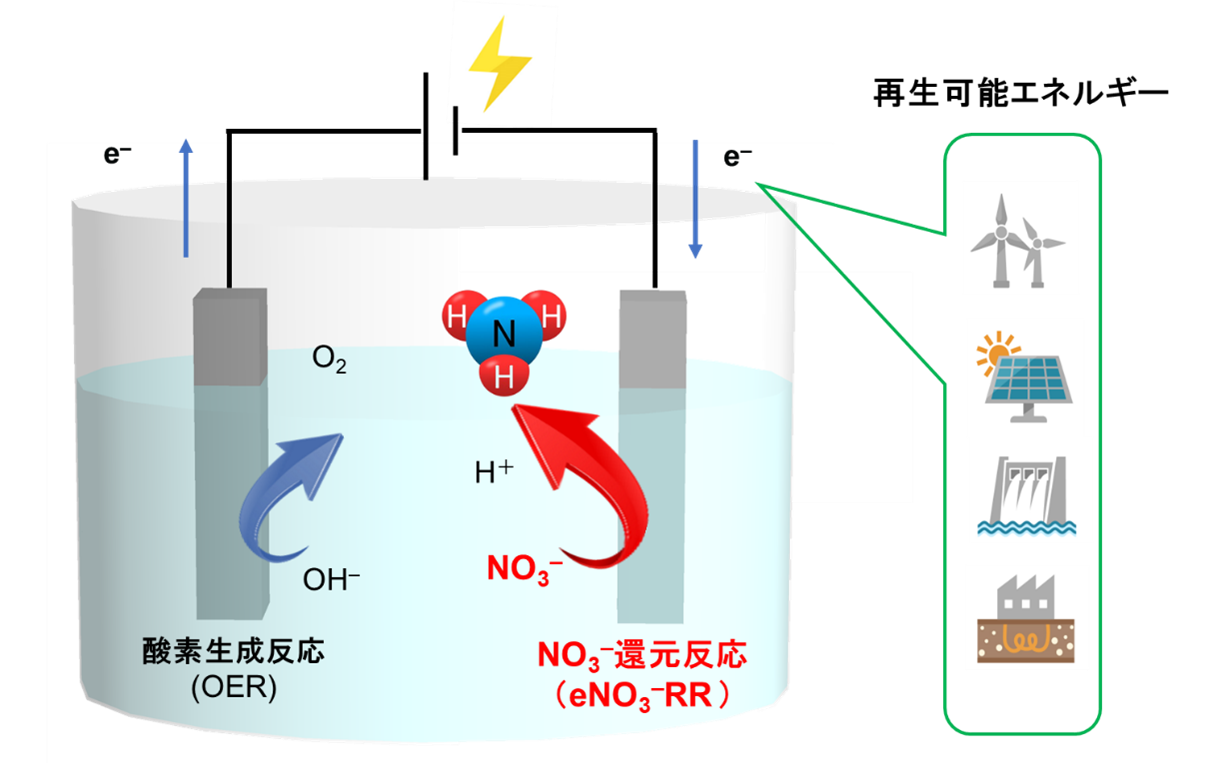 図1. 電気化学的硝酸イオン還元反応(eNO3–RR)の反応スキーム。水を電子源およびプロトン源として、工業・農業排水中の硝酸イオンを窒素源として、再生可能エネルギー由来の電力によって、常温・常圧の穏やかな条件下で、基礎化学品であるアンモニアを合成することが可能となる。
<関連情報>
- https://www.tohoku.ac.jp/japanese/2025/12/press20251211-01-ion.html
- https://www.tohoku.ac.jp/japanese/newimg/pressimg/tohokuuniv-press20251211_01web_ion.pdf
- https://pubs.acs.org/doi/10.1021/acscatal.5c04431
高選択的電気触媒硝酸塩還元のためのCu 14ナノクラスター上の活性金属部位の露出 Exposure of Active Metal Sites on Cu14 Nanoclusters for Highly Selective Electrocatalytic Nitrate Reduction
Shiho Tomihari,Maho Kamiyama,Harpriya Minhas,Tokuhisa Kawawaki,Kana Takemae,Yamato Shingyouchi,Ziyi Chen,Biswarup Pathak,and Yuichi Negishi
ACS Catalysis Published December 9, 2025
DOI:https://doi.org/10.1021/acscatal.5c04431
Abstract
Atomically precise metal nanoclusters (NCs) have been extensively used as catalysts for various reactions owing to the ultimate controllability of their parameters, such as number of constituent atoms, crystal structure, and alloying characteristics. However, for many metal NCs, their surfaces are entirely covered by ligands, preventing the exposure of surface metal atoms that serve as active sites and thus hindering their catalytic functionality. Herein, we report that the exposure of metal sites in Cu14 NC can be achieved by a facile modification of the thiolate ligands. Consequently, we found that Cu14 NC with an exposed Cu site exhibits significantly higher ammonia selectivity and production rate in electrochemical nitrate reduction. These findings underscore the importance of atomically precise control for metal NCs, not only of their overall geometric structures but also of their reactive sites, for achieving highly selective and active catalysts, contributing to the future design of diverse metal NC catalysts.