2026-01-08 コペンハーゲン大学(UCPH)
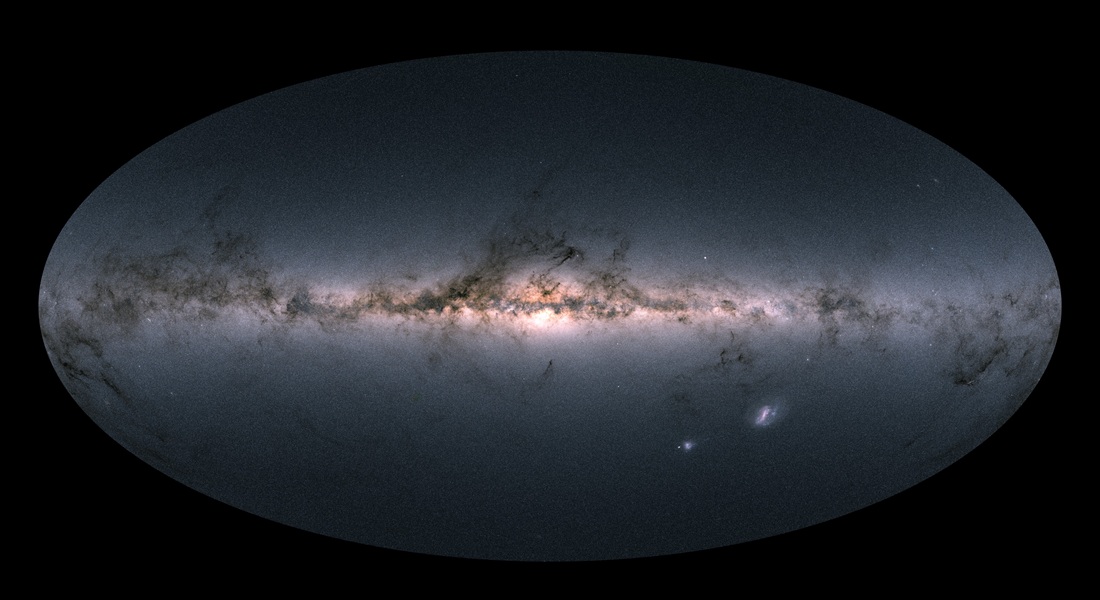
A map of the Milky Way based on data from ESA’s Gaia telescope (credit: ESA)
<関連情報>
- https://news.ku.dk/all_news/2026/01/how-many-ghost-particles-all-the-milky-ways-stars-send-towards-earth/
- https://journals.aps.org/prd/abstract/10.1103/tw4t-jk8d
天の川銀河の星からのニュートリノ Neutrinos from stars in the Milky Way
Pablo Martínez-Miravé and Irene Tamborra
Physical Review D Published: 7 January, 2026
DOI: https://doi.org/10.1103/tw4t-jk8d
Abstract
Neutrinos are produced during stellar evolution by means of thermal and thermonuclear processes. We model the cumulative neutrino flux expected at Earth from all stars in the Milky Way: the Galactic stellar neutrino flux (GSF). We account for the star formation history of our Galaxy and reconstruct the spatial distribution of Galactic stars by means of a random sampling procedure based on Gaia Data Release 2. We use the stellar evolution code mesa to compute the neutrino emission for a suite of stellar models with solar metallicity and zero-age-main-sequence mass between 0.08⊙ and 100⊙, from their premain sequence phase to their final fates. We then reconstruct the evolution of the neutrino spectral energy distribution for each stellar model in our suite. The GSF lies between (1) keV and (10) MeV, with thermal (thermonuclear) processes responsible for shaping neutrino emission at energies smaller (larger) than 0.1 MeV. Stars with mass larger than (1M⊙), located in the thin disk of the Galaxy, provide the largest contribution to the GSF. Moreover, most of the GSF originates from stars distant from Earth about 5–10 kpc, implying that a large fraction of stellar neutrinos can reach us from the Galactic Center. Solar neutrinos and the diffuse supernova neutrino background have energies comparable to those of the GSF, challenging the detection of the latter. However, directional information of solar neutrino and GSF events, together with the annual modulation of the solar neutrino flux, could facilitate the GSF detection; this will kick off a new era for low-energy neutrino astronomy, also providing a novel probe to discover new physics.