
2026-01-06 ワシントン大学セントルイス校
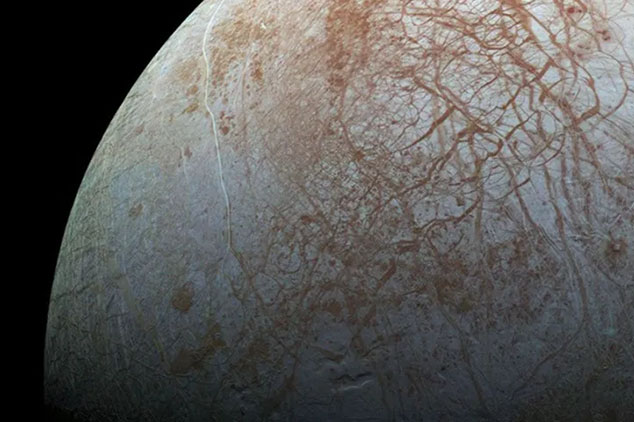
The surface of Jupiter’s icy moon Europa looms large in this color view, made from images taken by NASA’s Galileo spacecraft in the late 1990s. (Photo: NASA/JPL-Caltech/SETI Institute)
<関連情報>
- https://source.washu.edu/2026/01/jupiters-moon-europa-has-seafloor-that-may-be-quiet-lifeless/
- https://www.nature.com/articles/s41467-025-67151-3
現在、エウロパの海底には活断層はほとんど存在しない可能性が高い Little to no active faulting likely at Europa’s seafloor today
Paul K. Byrne,Henry G. Dawson,Christian Klimczak,Paul V. Regensburger,Kelsey T. Crane,Jeffrey G. Catalano,Catherine M. Elder,Bradford J. Foley,Christopher R. German,Austin P. Green,Douglas J. Hemingway,Mohit Melwani Daswani,Mark P. Panning,Noah Randolph-Flagg,Barbara Sherwood Lollar,Philip Skemer,Steven D. Vance & Douglas A. Wiens
Nature Communications Published:06 January 2026
DOI:https://doi.org/10.1038/s41467-025-67151-3
Abstract
Many of the outer Solar System’s icy satellites feature known or suspected subsurface oceans, at least some of which are likely situated atop rocky interiors. Water–rock interactions at and beneath these seafloors might support active chemoautotrophic habitats, with subseafloor fluid flow facilitated by active faulting and hydrothermal systems. Absent such phenomena, however, any attainment of chemical equilibrium between the seafloor and ocean might limit the availability of chemical energy for life. Here, we characterise the stress state of the seafloor of Jupiter’s moon Europa, and thus the prospect for fracturing and associated sub-seafloor fluid flow there. We consider stresses from tidal forcing, global contraction, mantle convection, and serpentinisation. We find that none of these mechanisms is likely able to drive slip along even weak, pre-existing fractures in the present. Ocean water–rock reactions taking place today are therefore probably restricted to fluid flow through only the upper few hundred metres of the seafloor. Any processes able to sustain habitable conditions at the Europan seafloor today must therefore be independent of ongoing tectonic activity.


