2026-01-06 北海道大学
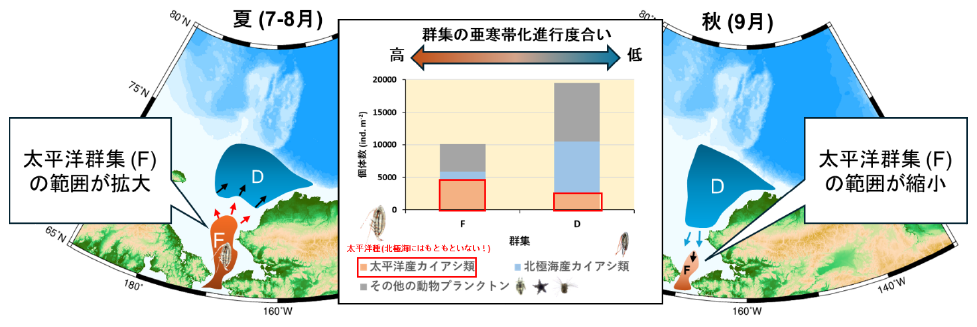
太平洋側北極海における亜寒帯化した動物プランクトン群集の季節変化の模式図。太平洋産種が多く、亜寒帯化が進行した群集F(オレンジ色)は、7-8月に見られるが、9月には範囲が減少し、従来の北極海群集D(青色)が増加。
<関連情報>
- https://www.hokudai.ac.jp/news/2026/01/12-5.html
- https://www.hokudai.ac.jp/news/pdf/260106_pr2.pdf
- https://www.sciencedirect.com/science/article/pii/S0079661125002228
2008-2021年の夏から秋にかけての西部北極海における動物プランクトン群集の時空間変動の総合解析 Synthesis of spatiotemporal variability in western Arctic zooplankton communities from summer to fall during 2008–2021
Jee-Hoon Kim, Yuya Hibino, Eun Jin Yang, Kyoung-Ho Cho, Hyoung Sul La, Sung-Ho Kang, Jeong-Hyun Kim, Hyeju Yoo, Jong-Kuk Moon, Yoshiyuki Abe, Nanami Hosoda, Atsushi Yamaguchi, Kohei Matsuno
Progress in Oceanography Available online: 4 December 2025
DOI:https://doi.org/10.1016/j.pocean.2025.103634
Highlights
- Long-term August (IBRV Araon) and September (RV Mirai) datasets revealed seasonal zooplankton community shifts.
- Pacific water inflow in August promoted warm, high-salinity conditions, facilitating the expansion of Pacific species.
- Small copepods remained dominant during the summer, but no clear increasing trend was observed in total abundance.
- Pacific-influenced communities declined by September, indicating high environmental dependency and incomplete establishment.
Abstract
The Arctic marine ecosystem is undergoing a major, rapid transformation driven by climate change, resulting in complex and unpredictable shifts in zooplankton communities, which are key pelagic food web components. We synthesized extensive multi-year zooplankton datasets (2008–2021) collected by a Korean icebreaker research vessel (IBRV Araon; August 2016–2021) and a Japanese research vessel (RV Mirai; September 2008, 2010, 2012–2017, and 2021) in the western Arctic Ocean to examine the effects of environmental factors on zooplankton distribution. We determined the effect of key environmental variables, including integrated mean temperature, mean salinity, and fluorescence, on zooplankton community structure. We identified six distinct zooplankton communities shaped by regional characteristics and interannual oceanographic variability. The pronounced seasonal transition of zooplankton communities from summer to autumn, particularly in the Chukchi Sea and the Chukchi Borderland in 2017 and 2021, was the major finding. During summer, Pacific water inflow into the Chukchi Sea significantly increased Pacific species (e.g., Metridia pacifica) and meroplankton (e.g., barnacle larvae), with barnacle larvae extending into the Chukchi Borderland in 2017 and 2021. Although small species (e.g., Pseudocalanus spp.) remained dominant during the summer, but no clear increasing trend was observed in total abundance within the Chukchi Sea. By September, these Pacific Ocean–influenced communities had decreased rapidly, suggesting their high environmental dependency and incomplete establishment in the region. This study integrates multi-year, seasonally diverse datasets collected across a broad spatial range, providing a comprehensive understanding of how Arctic zooplankton respond to climate-induced environmental changes.