
2026-01-05 スイス連邦工科大学ローザンヌ校(EPFL)
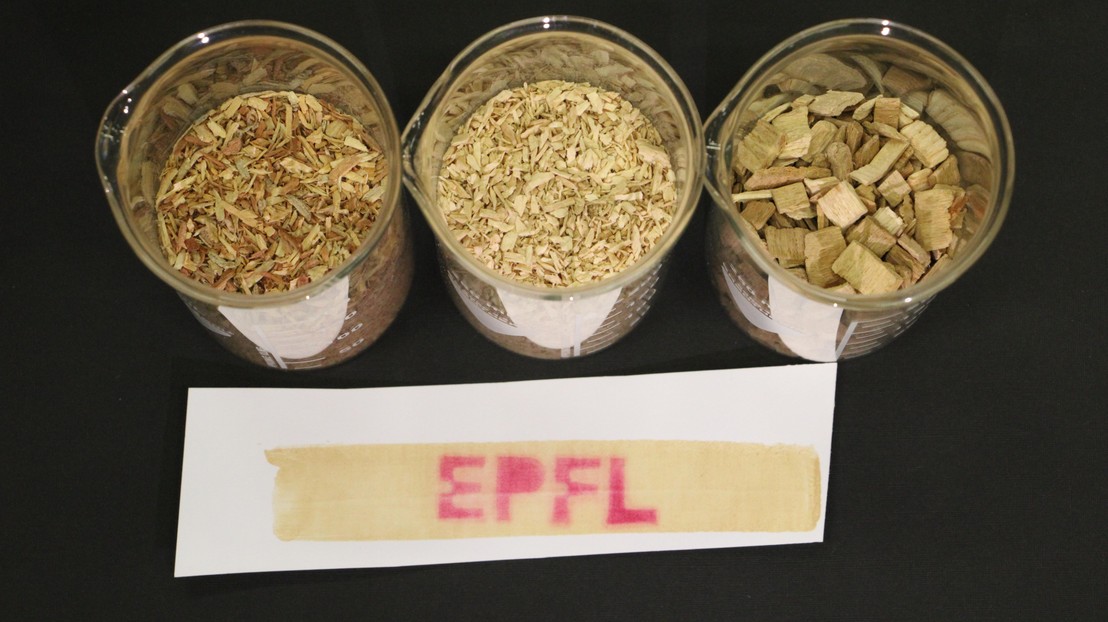
The EPFL logo printed on lignin-based thermal paper. 2026 EPFL/J. Luterbacher CC-BY-SA 4.0
<関連情報>
- https://actu.epfl.ch/news/safer-receipt-paper-from-wood/
- https://www.science.org/doi/10.1126/sciadv.adw9912
- https://www.science.org/doi/10.1126/science.1246748
リグノセルロース系バイオマス分画を用いた持続可能な感熱紙の配合 Sustainable thermal paper formulation using lignocellulosic biomass fractions
Tom Nelis, Manon Rolland, Claire L. Bourmaud, Etiënne L. M. Vermeirssen, […] , and Jeremy S. Luterbacher
Science Advances Published:2 Jan 2026
DOI:https://doi.org/10.1126/sciadv.adw9912
Abstract
Thermal paper presents widely recognized health hazards due to its formulations containing bisphenol A (BPA) and bisphenol S (BPS) as color developers with limited research on safer alternatives. Here, we introduce sustainable thermal paper formulations built with functionalized lignin polymers and lignin-derived esters, combined with a sensitizer derived from xylan. Light-colored lignin polymer was obtained via sequential aldehyde-assisted fractionation, which reduced chromophore concentration through multiple extraction cycles. Good performance was achieved with polymeric lignin (color density at 120°C ≈ 0.8 to 1.1) when combined with xylan-derived diformylxylose (DFX), each of which is produced directly by simple biomass fractionation. Coatings remained stable for over a year under ambient conditions. Last, lignin-based developers showed estrogenic activity that was two to three orders of magnitude lower than BPA and one to two orders of magnitude lower than BPS, while the DFX sensitizer showed no signs of estrogenic activity or toxicity to bacteria or algae.
バイオマス由来γ-バレロラクトンを用いたバイオマスからの非酵素的糖生産 Nonenzymatic Sugar Production from Biomass Using Biomass-Derived γ-Valerolactone
Jeremy S. Luterbacher, Jacqueline M. Rand, David Martin Alonso, Jeehoon Han, […] , and James A. Dumesic
Science Published:17 Jan 2014
DOI:https://doi.org/10.1126/science.1246748
Renewable Breakdown Routine
In order to transform cellulose-containing biomass into liquid fuels such as ethanol, it is first necessary to break down the cellulose into its constituent sugars. Efforts toward this end have focused on chemical protocols using concentrated acid or ionic liquid solvents, and on biochemical protocols using cellulase enzymes. Luterbacher et al. (p. 277) now show that γ-valerolactone, a small molecule solvent that can itself be sourced renewably from biomass, promotes efficient and selective thermal breakdown of cellulose in the presence of dilute aqueous acid.
Abstract
Widespread production of biomass-derived fuels and chemicals will require cost-effective processes for breaking down cellulose and hemicellulose into their constituent sugars. Here, we report laboratory-scale production of soluble carbohydrates from corn stover, hardwood, and softwood at high yields (70 to 90%) in a solvent mixture of biomass-derived γ-valerolactone (GVL), water, and dilute acid (0.05 weight percent H2SO4). GVL promotes thermocatalytic saccharification through complete solubilization of the biomass, including the lignin fraction. The carbohydrates can be recovered and concentrated (up to 127 grams per liter) by extraction from GVL into an aqueous phase by addition of NaCl or liquid CO2. This strategy is well suited for catalytic upgrading to furans or fermentative upgrading to ethanol at high titers and near theoretical yield. We estimate through preliminary techno-economic modeling that the overall process could be cost-competitive for ethanol production, with biomass pretreatment followed by enzymatic hydrolysis.


