
2025-12-16 シカゴ大学
<関連情報>
- https://pme.uchicago.edu/news/research-upturns-assumptions-about-battery-failure
- https://www.nature.com/articles/s41565-025-02079-9
単結晶電池正極におけるナノスケールのひずみ変化 Nanoscopic strain evolution in single-crystal battery positive electrodes
Jing Wang,Tongchao Liu,Weiyuan Huang,Lei Yu,Haozhe Zhang,Tao Zhou,Tianyi Li,Xiaojing Huang,Xianghui Xiao,Lu Ma,Martin V. Holt,Kun Ryu,Rachid Amine,Wenqian Xu,Luxi Li,Jianguo Wen,Ying Shirley Meng & Khalil Amine
Nature Nanotechnology Published:16 December 2025
DOI:https://doi.org/10.1038/s41565-025-02079-9
Abstract
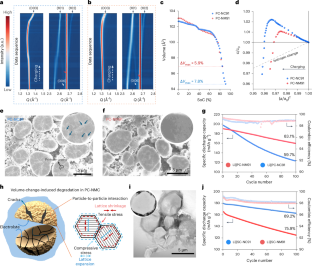
Single-crystal Ni-rich layered oxides (SC-NMC) with a grain-boundary-free configuration have effectively addressed the long-standing cracking issue of conventional polycrystalline Ni-rich materials (PC-NMC) in lithium-ion batteries, prompting a shift in optimization strategies. However, continued reliance on anisotropic lattice volume change—a well-established failure indicator in PC-NMC—as a metric for understanding strain and guiding compositional design for SC-NMC becomes controversial. Here, by leveraging multiscale diagnostic techniques, we unravelled the distinct nanoscopic strain evolution in SC-NMC during battery operation, challenging the conventional composition-driven strategies and mechanical degradation indicators used for PC-NMC. Through particle-level chemomechanical analysis, we reveal a decoupling between mechanical stability and lattice volume change in SC-NMC, identifying that structural instability in SC materials is primarily driven by multidimensional lattice distortions induced by kinetics-driven reaction heterogeneity and progressively deactivating chemical phases. Using this mechanical failure mode, we redefine the roles of cobalt and manganese in maintaining mechanical stability. Unlike cobalt’s detrimental role in PC-NMC, we find cobalt to be critical in enhancing the longevity of SC-NMC by mitigating localized strain along the extended diffusion pathway, whereas manganese exacerbates mechanical degradation.


