
2025-12-12 ジョージア工科大学(Georgia Tech)
<関連情報>
- https://research.gatech.edu/can-scientists-detect-life-without-knowing-what-it-looks-research-using-machine-learning-offers-new
- https://academic.oup.com/pnasnexus/article/4/11/pgaf334/8323799
質量分析データを用いた機械学習を用いた隕石および陸生サンプル中の非生物的有機物と生物的有機物の識別 Discriminating abiotic and biotic organics in meteorite and terrestrial samples using machine learning on mass spectrometry data
Daniel Saeedi ,Denise Buckner ,Thomas A Walton ,José C Aponte ,Amirali Aghazadeh
PNAS Nexus Published:8 November 2025
DOI:https://doi.org/10.1093/pnasnexus/pgaf334
Abstract
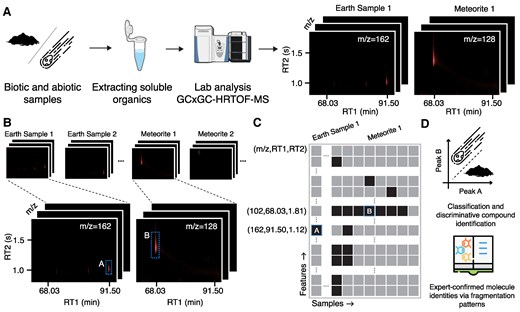
With the upcoming sample return missions to the Solar System where traces of past, extinct, or present life may be found, there is an urgent need to develop unbiased methods that can distinguish molecular distributions of organic compounds synthesized abiotically from those produced biotically but were subsequently altered through diagenetic processes. We conducted untargeted analyses on a collection of meteorite and terrestrial geologic samples using 2D gas chromatography coupled with high-resolution time-of-flight mass spectrometry and compared their soluble nonpolar and semipolar organic species. To deconvolute the resulting large dataset, we developed LifeTracer, a computational framework for processing and downstream machine learning analysis of mass spectrometry data. LifeTracer identified predictive molecular features that distinguish abiotic from biotic origins and enabled a robust classification of meteorites from terrestrial samples based on the composition of their nonpolar soluble organics.


