2025-12-12 ミュンヘン大学(LMU)
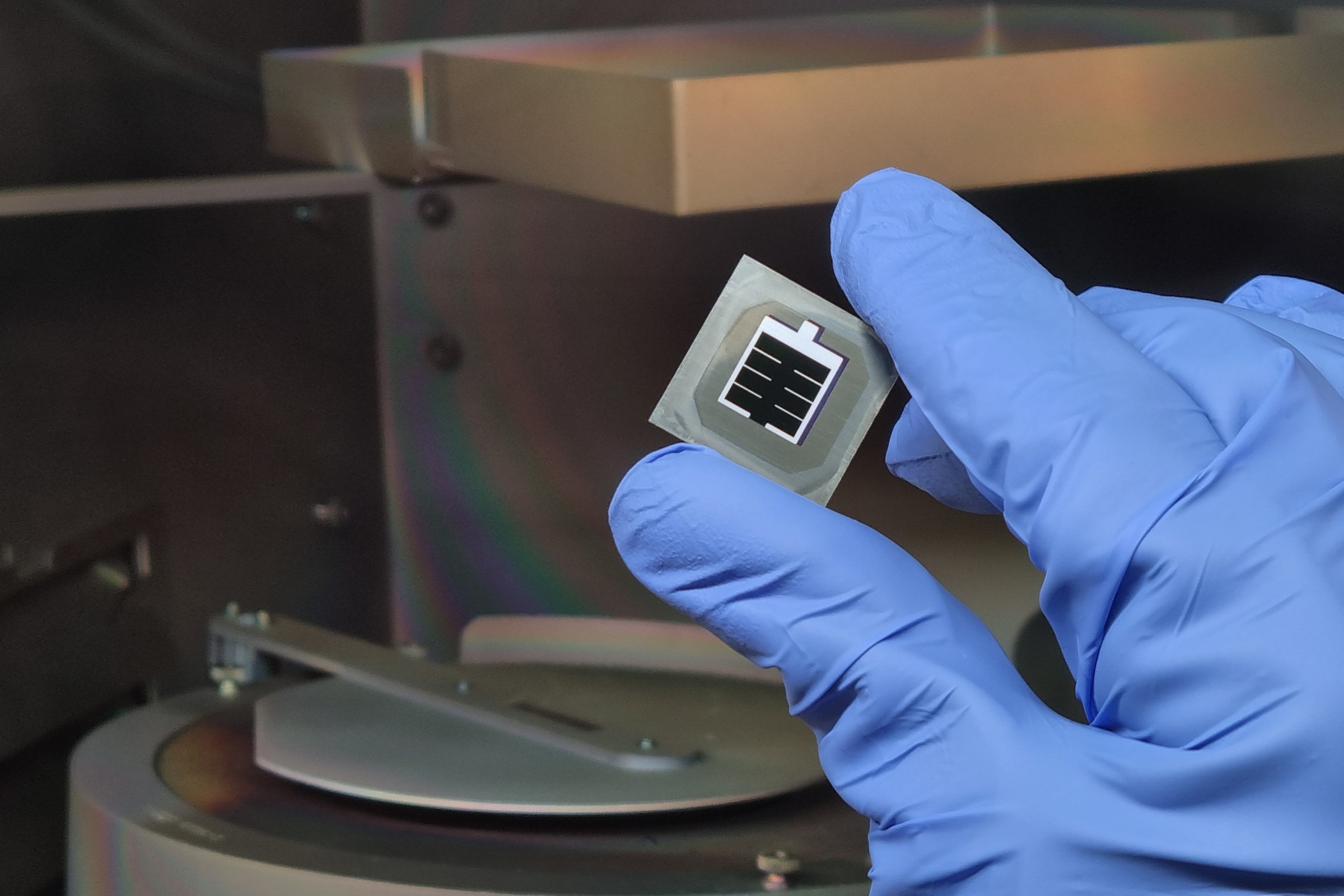
Perovskite-silicon tandem solar cells fabricated at LMU. | © Aydin Group
<関連情報>
- https://www.lmu.de/en/newsroom/news-overview/news/photovoltaics-molecular-fine-tuning-increases-efficiency-of-solar-cells-a41f234f.html
- https://www.sciencedirect.com/science/article/pii/S2542435125004088
分子接触官能化によるテクスチャードペロブスカイト-シリコンタンデム太陽電池の電荷抽出の向上 Enhanced charge extraction in textured perovskite-silicon tandem solar cells via molecular contact functionalization
Jian Huang, Letian Zhang, Cem Yilmaz, Geping Qu, Ido Zemer, Rik Hooijer, Siyuan Cai, Ali Buyruk, Hao Zhu, Meriem Bouraoui, Achim Hartschuh, Ryota Mishima, Kenji Yamamoto, Caner Deger, Ilhan Yavuz, Alex K.-Y. Jen, Esma Ugur, Stefaan De Wolf, Igal Levine, Zong-Xiang Xu,…,Erkan Aydin
Joule Available online 11 December 2025
DOI:https://doi.org/10.1016/j.joule.2025.102227
Highlights
- Bromine-functionalized SAMs improve charge extraction on textured interfaces
- Conjugated linkers enable denser molecular packing and enhanced stability
- Synergy of halogen and conjugation gives stable, efficient perovskite-silicon tandems
Context & scale
Monolithic perovskite/silicon tandem solar cells have emerged as a promising route toward high-efficiency, cost-competitive photovoltaics, which has surpassed the theoretical efficiency limit of single-junction devices. Within this field, p–i–n perovskite architectures are attracting attention for their simple fabrication and effective optical management. Self-assembled molecules (SAMs) play a key role in these devices as tunable hole-selective layers that improve energy-level alignment and suppress carrier recombination at the perovskite/recombination layer interface. Despite these advances, achieving uniform and stable SAM coverage on textured surfaces remains a major challenge for perovskite/silicon tandems.
In this work, we discovered that trace brominated impurities in a commercial SAM, 4PADCB, unexpectedly enhanced tandem performance. Guided by this observation, we designed and synthesized a bromine-substituted analog, Bz-PhpPABrCz ((4-(5-bromo-7H-dibenzo[c,g]carbazol-7-yl)phenyl)phosphonic acid), and combined it with Bz-PhpPACz ((4-(7H-dibenzo[c,g]carbazol-7-yl)phenyl)phosphonic acid) to form a binary mixed SAM. The conjugated aromatic linkers in these molecules promote denser molecular packing, while bromine substitution facilitates interfacial passivation and efficient hole extraction on rough, textured surfaces. As a result, perovskite films deposited on the bromine-engineered SAM exhibited reduced lattice strain, enhanced crystallinity, and improved charge extraction efficiency, leading to higher fill factors and power conversion efficiencies. Stability tests further confirmed the robustness of the conjugated SAMs under operational conditions.
These results demonstrate that rational incorporation of halogen functionalities into SAM structures provides an effective route to improve interfacial quality and charge transport in textured perovskite-silicon tandems, while the conjugated linkers within the SAMs enable denser coverage on textured surfaces and contribute to enhanced device stability.
Summary
High-efficiency perovskite-silicon tandem solar cells require effective charge recombination at the interconnecting junction. On textured silicon bottom cells, conventional alkyl-chain-based self-assembled molecules (SAMs) tend to aggregate, limiting device performance. To overcome this, we synthesized a conjugated linker SAM, (4-(7H-dibenzo[c,g]carbazol-7-yl)phenyl)phosphonic acid (Bz-PhpPACz), enabling efficient charge transport. Our molecular design included controlling bromine (Br) impurities in the SAM precursors, as chemical analysis revealed that commercial 4PADCB contains trace bromine species that passivate interface defects. We optimized the molecular mixture by precisely blending brominated and non-brominated counterparts. The conjugated framework promotes charge transport on rough surfaces, while bromine improves energy alignment, passivates defects, and relieves lattice strain in the perovskite layer. This approach yielded perovskite-silicon tandem cells on Czochralski (CZ) silicon with 31.4% efficiency, highlighting the critical role of molecular design and impurity control in achieving high-performance tandem devices.