2025-12-04 国立天文台
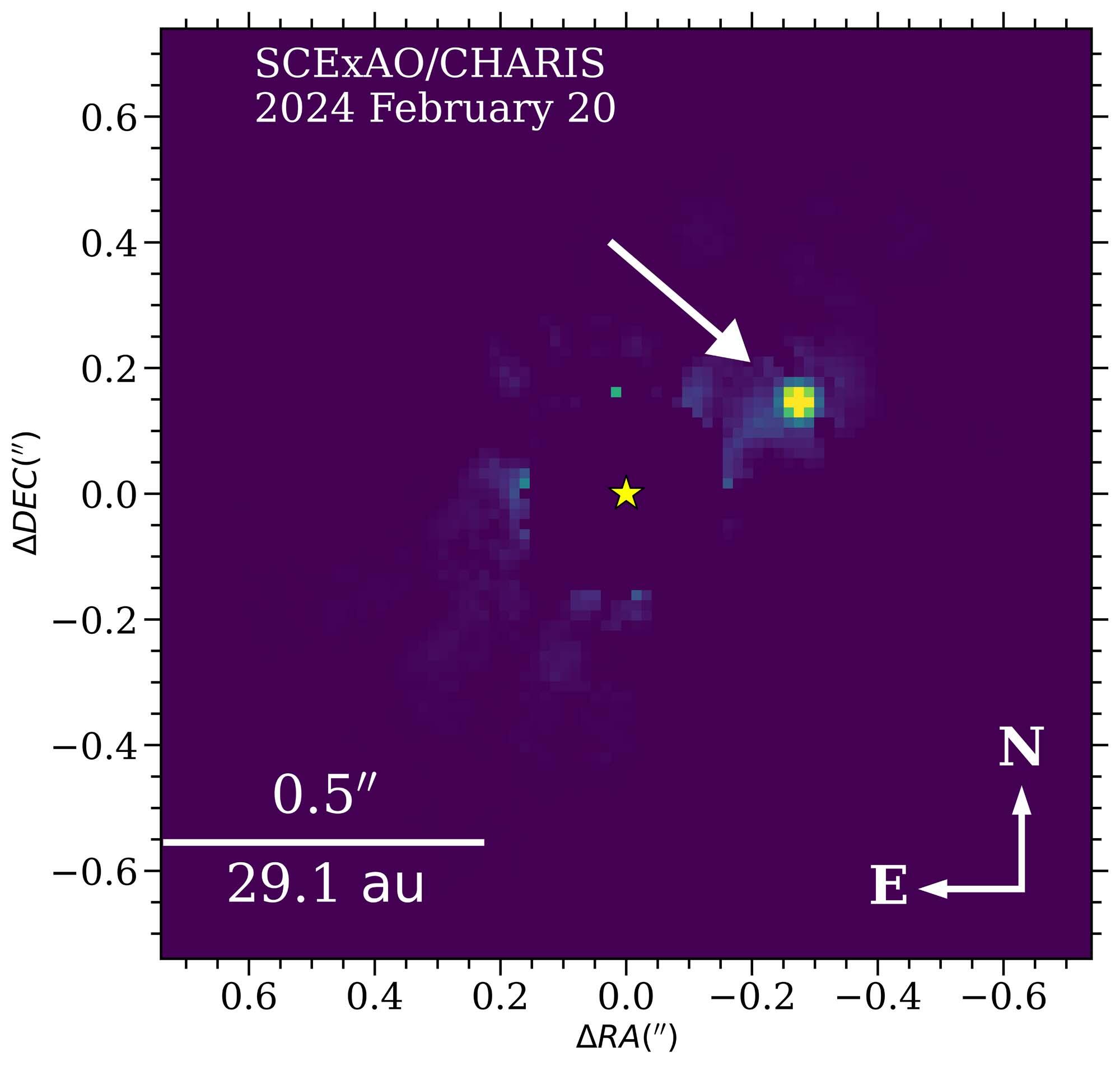
図2:発見された褐色矮星 HIP 71618 B の画像(矢印で示された天体)。星のマークは主星(HIP 71618)の位置を示しています。(クレジット:T. Currie/Subaru Telescope, UTSA)
<関連情報>
- https://www.nao.ac.jp/news/science/2025/20251204-subaru.html
- https://subarutelescope.org/jp/results/2025/12/03/3625.html
- https://iopscience.iop.org/article/10.3847/1538-3881/ae1a82
- https://iopscience.iop.org/article/10.3847/2041-8213/ae195f
SCExAO/CHARISとGaiaによる加速星HIP 54515からの3–4λ / Dの超木星型惑星の直接撮影と天体測定による発見 SCExAO/CHARIS and Gaia Direct Imaging and Astrometric Discovery of a Superjovian Planet 3–4 λ/D from the Accelerating Star HIP 54515
Thayne Currie, Yiting Li, Mona El Morsy, Brianna Lacy, Maria Vincent, Taylor L. Tobin, Masayuki Kuzuhara, Jeffrey Chilcote, Olivier Guyon, Ziying Gu,…
The Astrophysical Journal Published: 2025 December 3
DOI:10.3847/1538-3881/ae1a82
Abstract
We present the discovery of a superjovian planet around the young A5 star HIP 54515, detected using precision astrometry from the Hipparcos Gaia Catalogue of Accelerations and high-contrast imaging with SCExAO/CHARIS from the recently commenced OASIS program. SCExAO/CHARIS detects HIP 54515 b in five epochs 0.”145–0.”192 from the star (∼3–4 λ/D at 1.65 μm), exhibiting clockwise orbital motion. HIP 54515 b lies near the M/L transition with a luminosity of log(L/L⊙) ∼−3.52 ± 0.03. Dynamical modeling constrains its mass and mass ratio to be 17.7+7.6-4.9MJup and 0.0090+0.0036-0.0024 and favors a ∼25 au semimajor axis. HIP 54515 b adds to a growing list of superjovian planets with moderate eccentricities (e ≈ 0.4). Now, the third planet discovered from surveys combining high-contrast extreme adaptive optics imaging with precision astrometry, HIP 54515 b, should help improve empirical constraints on the luminosity evolution and eccentricity distribution of the most massive planets. It may also provide a key technical test of the Roman Space Telescope Coronagraph Instrument’s performance in the low stellar flux, small angular separation limit, and a demonstration of its ability to yield constrainable planet spectral properties.
OASISサーベイによるHIP 71618 Bの直接撮像と天体測定による発見:ローマのコロナグラフ技術実証に適した恒星近傍の天体 OASIS Survey Direct Imaging and Astrometric Discovery of HIP 71618 B: A Substellar Companion Suitable for the Roman Coronagraph Technology Demonstration
Mona El Morsy, Thayne Currie, Brianna Lacy, Taylor L. Tobin, Qier An, Yiting Li, Ziying Gu, Masayuki Kuzuhara, Danielle Bovie, Dillon Peng,…
The Astrophysical Journal Letters Published: 2025 December 3
DOI:10.3847/2041-8213/ae195f
Abstract
We present the OASIS survey program discovery of a substellar companion orbiting the young A1V star HIP 71618, detected using precision astrometry from Gaia and Hipparcos and high-contrast imaging with SCExAO/CHARIS and Keck/NIRC2. Atmospheric modeling favors a spectral type of M5–M8 and a temperature of ∼2700 ± 100 K. Dynamical modeling constrains HIP 71618 B’s mass to be 60+27-21MJup or 65+54-29MJup, depending on the adopted companion mass prior. It has a nearly-edge-on 11 au orbit with high eccentricity. HIP 71618 B will be located within the Roman Coronagraph’s dark-hole region during the instrument’s technological demonstration phase. A high-signal-to-noise-ratio detection of HIP 71618 B at 575 nm would demonstrate a 5σ contrast of 10−7 or better. The system is also located within or very close to the Roman Coronagraph’s Continuous Viewing Zone—near multiple candidate reference stars for dark-hole digging—and its primary is bright (V ≈ 5). The suitability of HIP 71618 as a potential Roman Coronagraph target for demonstrating the instrument’s core requirement (TTR5) should motivate the timely deep vetting of candidate reference stars.