2025-12-03 英国研究イノベーション機構(UKRI)
<関連情報>
- https://www.ukri.org/news/uk-scientists-rule-out-fourth-neutrino-in-search-for-new-physics/
- https://www.nature.com/articles/s41586-025-09757-7
MicroBooNEで2本のニュートリノビームによる軽いステライルニュートリノの探索 Search for light sterile neutrinos with two neutrino beams at MicroBooNE
The MicroBooNE Collaboration
Nature Published:03 December 2025
DOI:https://doi.org/10.1038/s41586-025-09757-7
Abstract
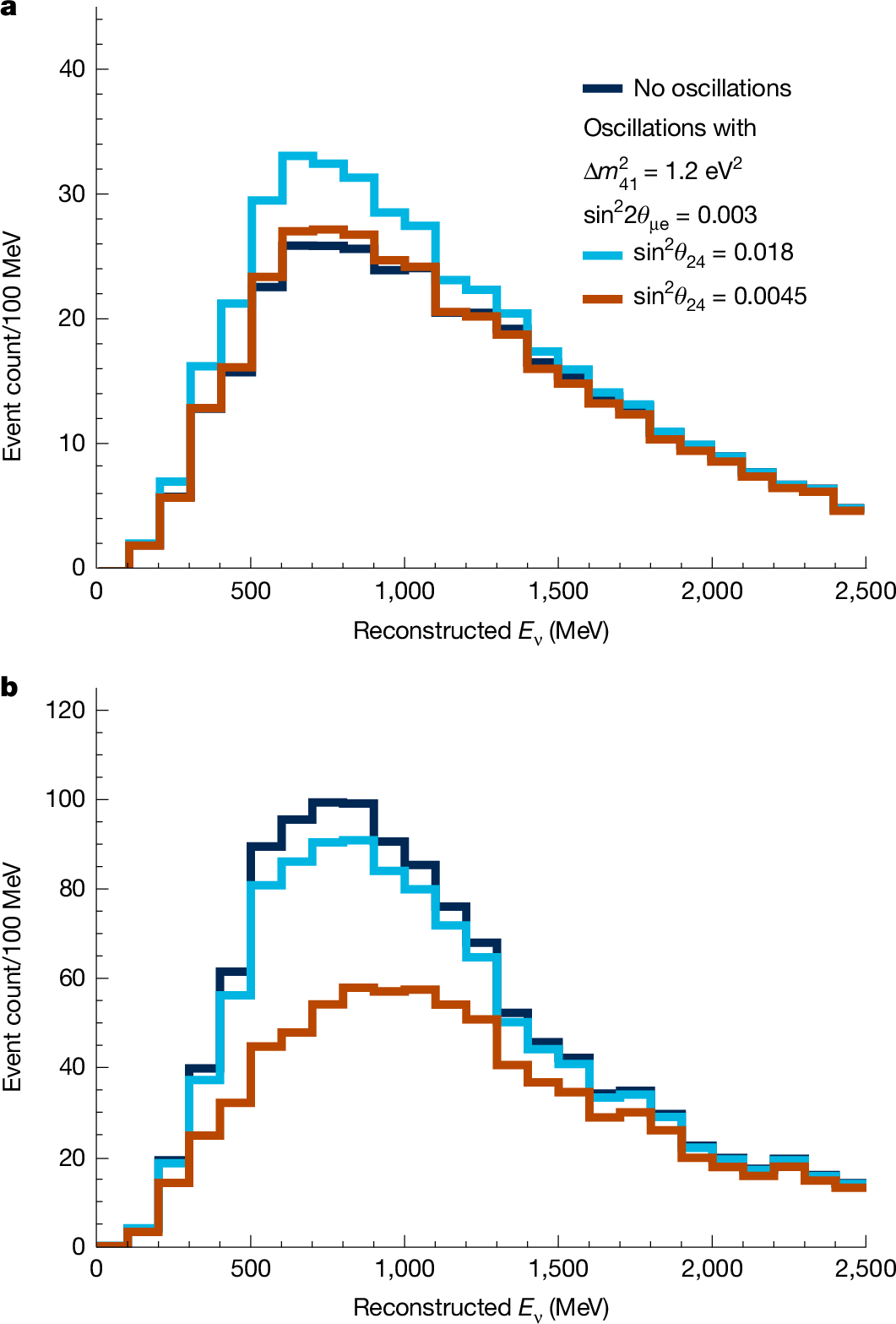
The existence of three distinct neutrino flavours, νe, νμ and ντ, is a central tenet of the Standard Model of particle physics1,2. Quantum-mechanical interference can allow a neutrino of one initial flavour to be detected sometime later as a different flavour, a process called neutrino oscillation. Several anomalous observations inconsistent with this three-flavour picture have motivated the hypothesis that an additional neutrino state exists, which does not interact directly with matter, termed as ‘sterile’ neutrino, νs (refs. 3,4,5,6,7,8,9). This includes anomalous observations from the Liquid Scintillator Neutrino Detector (LSND)3 experiment and Mini-Booster Neutrino Experiment (MiniBooNE)4,5, consistent with νμ → νe transitions at a distance inconsistent with the three-neutrino picture. Here we use data obtained from the MicroBooNE liquid-argon time projection chamber10 in two accelerator neutrino beams to exclude the single light sterile neutrino interpretation of the LSND and MiniBooNE anomalies at the 95% confidence level (CL). Moreover, we rule out a notable portion of the parameter space that could explain the gallium anomaly6,7,8. This is one of the first measurements to use two accelerator neutrino beams to break a degeneracy between νe appearance and disappearance, which would otherwise weaken the sensitivity to the sterile neutrino hypothesis. We find no evidence for either νμ → νe flavour transitions or νe disappearance that would indicate non-standard flavour oscillations. Our results indicate that previous anomalous observations consistent with νμ → νe transitions cannot be explained by introducing a single sterile neutrino state.