
2025-11-26 ラトガース大学
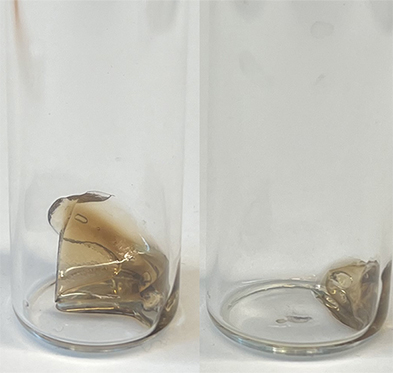
A sample of poly(dicyclopentadiene) plastic, which is a material often used in car bumpers and farm equipment that is difficult to degrade, made with the Rutgers scientists’ process using degradable chemistry. The chemical structure is designed so the plastic starts breaking down on its own within a few days at normal room conditions. On the left is the original sample; on the right is the same sample after 18 hours in the open air.Gu Lab
<関連情報>
- https://www.rutgers.edu/news/scientists-develop-plastics-can-break-down-tackling-pollution
- https://www.nature.com/articles/s41557-025-02007-3
隣接基の配座的前組織化はポリマーの自己分解を調節し促進する Conformational preorganization of neighbouring groups modulates and expedites polymer self-deconstruction
Shaozheng Yin,Rui Zhang,Ruihao Zhou,N. Sanjeeva Murthy,Lu Wang & Yuwei Gu
Nature Chemistry Published:28 November 2025
DOI:https://doi.org/10.1038/s41557-025-02007-3
Abstract
Controlling the rate at which polymers break down is essential for developing sustainable materials. Conventional approaches—which rely on introducing labile and cleavable bonds—often face an inherent trade-off between stability and ease of deconstruction. Inspired by self-deconstruction mechanisms in biomacromolecules, we leverage conformational preorganization of neighbouring groups to modulate and expedite polymer self-deconstruction. Here we show that precise spatial alignment of nucleophilic groups relative to labile bonds regulates the cleavage kinetics by shifting the conformational ensemble towards reactive geometries. This strategy enables programmable deconstruction of both linear polymers and bulk thermosetting networks under ambient conditions, with rates tunable across several orders of magnitude—without altering the chemical identity of the cleavable bond or compromising the polymers’ physical properties. Furthermore, even distal intramolecular functionalities can be harnessed to dynamically control bond cleavability through metal-induced polymer folding, enabling reversible activation and deactivation of self-deconstruction. This work establishes conformational control as a powerful strategy for fine-tuning polymer deconstruction.


