2025-11-20 NASA
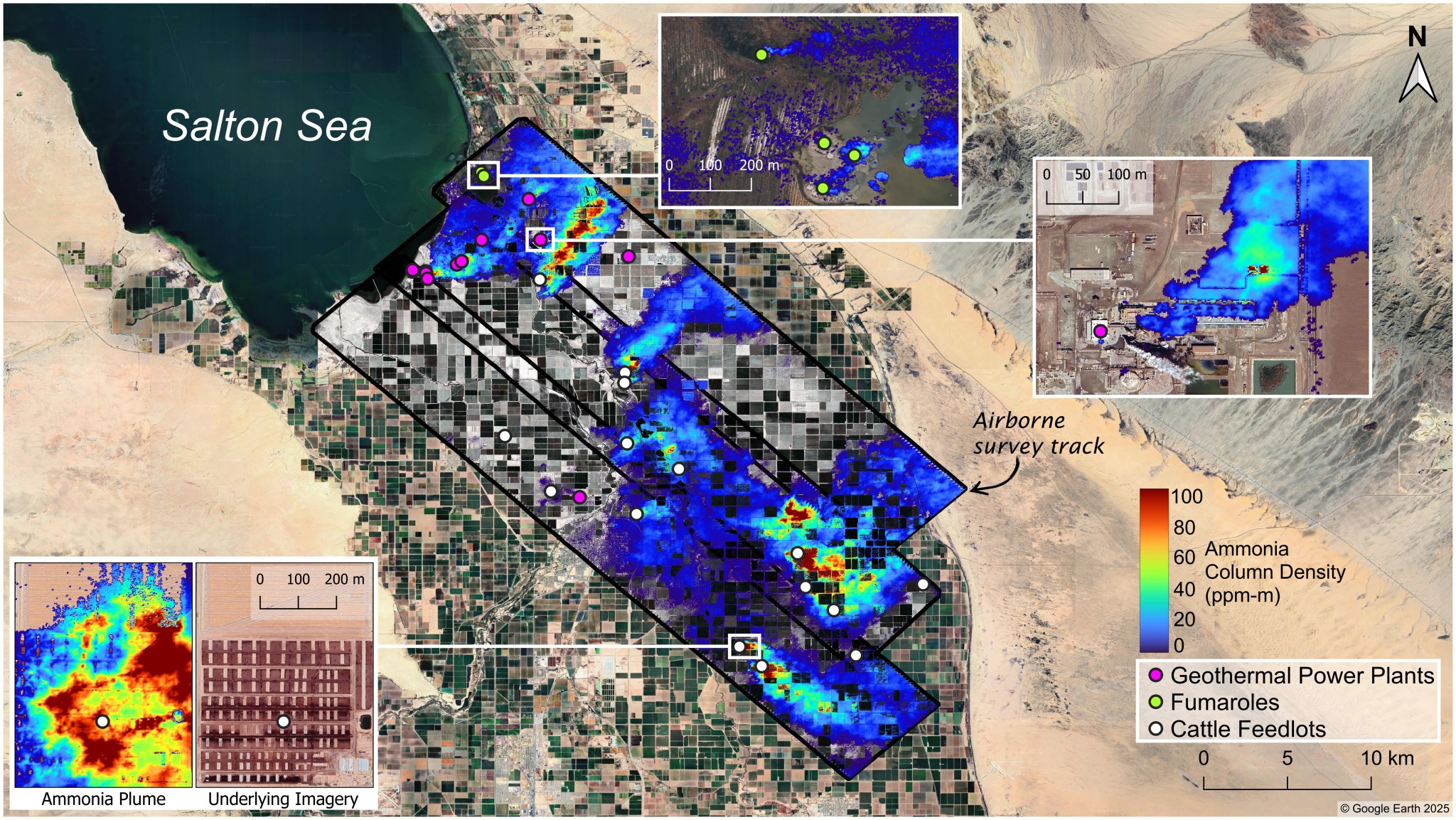
Researchers used data taken in March 2023 by an airborne imaging spectrometer to map ammonia emissions in the Imperial Valley. Produced by agricultural activities as well as geothermal processes, ammonia is a precursor to particulate matter, which can cause adverse health outcomes when inhaled.NASA/JPL-Caltech
<関連情報>
- https://www.nasa.gov/missions/maia/nasa-aerospace-corporation-study-sharpens-focus-on-ammonia-emissions/
- https://acp.copernicus.org/articles/25/11935/2025/
- https://agupubs.onlinelibrary.wiley.com/doi/10.1029/2020GL090579
カリフォルニア州ソルトン海地域におけるアンモニア排出源の追跡:航空機搭載長波赤外線ハイパースペクトル画像と地上監視からの知見 Tracing ammonia emission sources in California’s Salton Sea region: insights from airborne longwave-infrared hyperspectral imaging and ground monitoring
Sina Hasheminassab, David M. Tratt, Olga V. Kalashnikova, Clement S. Chang, Morad Alvarez, Kerry N. Buckland, Michael J. Garay, Francesca M. Hopkins, Eric R. Keim, Le Kuai, Yaning Miao, Payam Pakbin, William C. Porter, and Mohammad H. Sowlat
Atmospheric Chemistry and Physics Published:02 Oct 2025
DOI:https://doi.org/10.5194/acp-25-11935-2025
Abstract
Ammonia (NH3) plays an important role in atmospheric chemistry and air quality, but its emissions remain poorly constrained due to its short atmospheric lifetime, high spatial heterogeneity, and limited coverage of existing monitoring resources. This study integrates airborne longwave-infrared (LWIR) hyperspectral imaging at ∼2 m spatial resolution with ground-based stationary and mobile in situ measurements to map and characterize NH3 emissions in two regions near the Salton Sea in southern California: Mecca in the northwest and Imperial in the southeast. Airborne surveys conducted in March and September 2023 with a wide-swath LWIR spectral imager revealed pronounced spatial and seasonal variability. Average NH3 levels in Imperial were 2.5–8 times higher than those in Mecca, linked primarily to large, concentrated animal feeding operations (CAFOs), geothermal power plants, fumaroles, and intensive agricultural activities. Ground-based mobile monitoring corroborated these findings, showing elevated NH3 levels near these sources and especially high NH3 concentrations downwind of CAFOs with large cattle populations. The results underscore the utility of airborne LWIR hyperspectral imaging in detecting and mapping NH3 at hyperlocal scales, including sources absent from existing inventories. They further highlight the need for routine airborne campaigns and the development of next-generation satellite missions with higher spatial resolution to achieve comprehensive, large-area monitoring. These findings inform air quality management strategies and emphasize the importance of improving emission inventories for effective mitigation of NH3-driven air pollution.
2km解像度におけるアメリカ合衆国本土上空のアンモニアの月別パターン Monthly Patterns of Ammonia Over the Contiguous United States at 2-km Resolution
Rui Wang, Xuehui Guo, Da Pan, James T. Kelly, Jesse O. Bash, Kang Sun, Fabien Paulot, Lieven Clarisse, Martin Van Damme, Simon Whitburn, Pierre-François Coheur, Cathy Clerbaux, Mark A. Zondlo
Geophysical Research Letters Published: 22 December 2020
DOI:https://doi.org/10.1029/2020GL090579
Abstract
Monthly, high-resolution (∼2 km) ammonia (NH3) column maps from the Infrared Atmospheric Sounding Interferometer (IASI) were developed across the contiguous United States and adjacent areas. Ammonia hotspots (95th percentile of the column distribution) were highly localized with a characteristic length scale of 12 km and median area of 152 km2. Five seasonality clusters were identified with k-means++ clustering. The Midwest and eastern United States had a broad, spring maximum of NH3 (67% of hotspots in this cluster). The western United States, in contrast, showed a narrower midsummer peak (32% of hotspots). IASI spatiotemporal clustering was consistent with those from the Ammonia Monitoring Network. CMAQ and GFDL-AM3 modeled NH3 columns have some success replicating the seasonal patterns but did not capture the regional differences. The high spatial-resolution monthly NH3 maps serve as a constraint for model simulations and as a guide for the placement of future, ground-based network sites.
Plain Language Summary
Ammonia (NH3) contributes to the formation of particulate matter, which is known to degrade air quality and human health. The major source of NH3 is from agricultural activities, yet observational constraints on NH3 are limited, particularly at both monthly resolution and high spatial resolution. We have developed high spatial resolution (2 km) satellite maps of NH3 on a monthly scale in the United States. Areas with the highest NH3 are generally very localized with typical length scales of ∼12 km. The seasonal patterns varied dramatically based upon the underlying agricultural activities. These high-resolution satellite maps can be used as observational constraints on the seasonalities and spatial patterns for modeling of atmospheric NH3.
Key Points
- High spatial resolution (2 km) maps of NH3 show that hotspots are highly localized with characteristic length scales of ∼12 km
- Large monthly variations of NH3 columns are observed with different seasonality patterns by region and type of agricultural activities
- Satellite NH3 maps provide insights for future ground-based observational networks and constraints for model NH3 spatiotemporal patterns