2025-11-20 中国科学院(CAS)
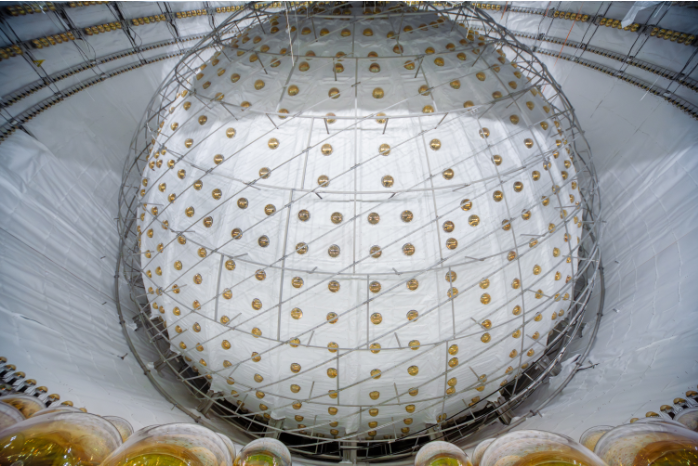
The JUNO detector seen from outside. (Image by JUNO Collaboration)
<関連情報>
- https://english.cas.cn/newsroom/research-news/202602/t20260210_1150570.shtml
- https://arxiv.org/abs/2511.14590
- https://arxiv.org/abs/2511.14593
JUNO検出器の初期性能結果 Initial performance results of the JUNO detector
Angel Abusleme, Thomas Adam, Kai Adamowicz, David Adey, Shakeel Ahmad, Rizwan Ahmed, Timo Ahola, Sebastiano Aiello, Fengpeng An, Guangpeng An, Costas Andreopoulos, Giuseppe Andronico, João Pedro Athayde Marcondes de André, Nikolay Anfimov, Vito Antonelli, Tatiana Antoshkina, Burin Asavapibhop, Didier Auguste, Margherita Buizza Avanzini, Andrej Babic, Jingzhi Bai, Weidong Bai, Nikita Balashov, Roberto Barbera, Andrea Barresi, Davide Basilico, Eric Baussan, Beatrice Bellantonio, Marco Bellato, JeanLuc Beney, Marco Beretta, Antonio Bergnoli, Enrico Bernieri, Nikita Bessonov, David Biaré, Daniel Bick, Lukas Bieger, Svetlana Biktemerova, Thilo Birkenfeld, David Blum, Simon Blyth, Sara Boarin, Manuel Boehles, Anastasia Bolshakova, Mathieu Bongrand, Aurélie Bonhomme, Clément Bordereau, Matteo Borghesi, Augusto Brigatti, Timothee Brugiere, Riccardo Brugnera, Riccardo Bruno, Jonas Buchholz, Antonio Budano, Max Buesken, Mario Buscemi, Severino Bussino, Jose Busto, Ilya Butorov, Marcel Büchner, Anatael Cabrera, Barbara Caccianiga, Boshuai Cai, Hao Cai, Xiao Cai, Yanke Cai, Yi-zhou Cai, Zhiyan Cai, Stéphane Callier, Steven Calvez, Antonio Cammi, Agustin Campeny, Dechang Cai, Chuanya Cao, Dewen Cao, Guofu Cao, Jun Cao, Yaoqi Cao, Rossella Caruso, Aurelio Caslini, Cédric Cerna, Vanessa Cerrone, Daniele Cesini, Chi Chan, Jinfan Chang, Yun Chang, Milo Charavet, Tim Charissé, Auttakit Chatrabhuti, Chao Chen, Guoming Chen, Haitao Chen, Haotian Chen, Jiahui Chen, Jian Chen, Jing Chen, Junyou Chen, Lihao Chen, Mali Chen, Mingming Chen et al. (1039 additional authors not shown)
arXiv Submitted on 18 Nov 2025
DOI:https://doi.org/10.48550/arXiv.2511.14590
Abstract
The Jiangmen Underground Neutrino Observatory (JUNO) started physics data taking on 26 August 2025. JUNO consists of a 20-kton liquid scintillator central detector, surrounded by a 35 kton water pool serving as a Cherenkov veto, and almost 1000 m2 of plastic scintillator veto on top. The detector is located in a shallow underground laboratory with an overburden of 1800 m.w.e. This paper presents the performance results of the detector, extensively studied during the commissioning of the water phase, the subsequent liquid scintillator filling phase, and the first physics runs. The liquid scintillator achieved an attenuation length of 20.6 m at 430 nm, while the high coverage PMT system and scintillator together yielded about 1785 photoelectrons per MeV of energy deposit at the detector centre, measured using the 2.223 MeV γ from neutron captures on hydrogen with an Am-C calibration source. The reconstructed energy resolution is 3.4% for two 0.511 MeV γ at the detector centre and 2.9% for the 0.93 MeV quenched Po-214 alpha decays from natural radioactive sources. The energy nonlinearity is calibrated to better than 1%. Intrinsic contaminations of U-238 and Th-232 in the liquid scintillator are below 10-16 g/g, assuming secular equilibrium. The water Cherenkov detector achieves a muon detection efficiency better than 99.9% for muons traversing the liquid scintillator volume. During the initial science runs, the data acquisition duty cycle exceeded 97.8%, demonstrating the excellent stability and readiness of JUNO for high-precision neutrino physics.
JUNOにおける原子炉ニュートリノ振動の初測定 First measurement of reactor neutrino oscillations at JUNO
Angel Abusleme, Thomas Adam, Kai Adamowicz, David Adey, Shakeel Ahmad, Rizwan Ahmed, Timo Ahola, Sebastiano Aiello, Fengpeng An, Guangpeng An, Costas Andreopoulos, Giuseppe Andronico, João Pedro Athayde Marcondes de André, Nikolay Anfimov, Vito Antonelli, Tatiana Antoshkina, Burin Asavapibhop, Didier Auguste, Margherita Buizza Avanzini, Andrej Babic, Jingzhi Bai, Weidong Bai, Nikita Balashov, Roberto Barbera, Andrea Barresi, Davide Basilico, Eric Baussan, Beatrice Bellantonio, Marco Bellato, JeanLuc Beney, Marco Beretta, Antonio Bergnoli, Enrico Bernieri, Nikita Bessonov, David Biaré, Daniel Bick, Lukas Bieger, Svetlana Biktemerova, Thilo Birkenfeld, David Blum, Simon Blyth, Sara Boarin, Manuel Boehles, Anastasia Bolshakova, Mathieu Bongrand, Aurélie Bonhomme, Clément Bordereau, Matteo Borghesi, Augusto Brigatti, Timothee Brugiere, Riccardo Brugnera, Riccardo Bruno, Jonas Buchholz, Antonio Budano, Max Buesken, Mario Buscemi, Severino Bussino, Jose Busto, Ilya Butorov, Marcel Büchner, Anatael Cabrera, Barbara Caccianiga, Boshuai Cai, Hao Cai, Xiao Cai, Yanke Cai, Yi-zhou Cai, Zhiyan Cai, Stéphane Callier, Steven Calvez, Antonio Cammi, Agustin Campeny, Dechang Cai, Chuanya Cao, Dewen Cao, Guofu Cao, Jun Cao, Yaoqi Cao, Rossella Caruso, Aurelio Caslini, Cédric Cerna, Vanessa Cerrone, Daniele Cesini, Chi Chan, Jinfan Chang, Yun Chang, Milo Charavet, Tim Charissé, Auttakit Chatrabhuti, Chao Chen, Guoming Chen, Haitao Chen, Haotian Chen, Jiahui Chen, Jian Chen, Jing Chen, Junyou Chen, Lihao Chen, Mali Chen, Mingming Chen et al. (1039 additional authors not shown)
arXiv Submitted on 18 Nov 2025
DOI:https://doi.org/10.48550/arXiv.2511.14593
Abstract
Neutrino oscillations, a quantum effect manifesting at macroscopic scales, are governed by lepton flavor mixing angles and neutrino mass-squared differences that are fundamental parameters of particle physics, representing phenomena beyond the Standard Model. Precision measurements of these parameters are essential for testing the completeness of the three-flavor framework, determining the mass ordering of neutrinos, and probing possible new physics. The Jiangmen Underground Neutrino Observatory (JUNO) is a 20 kton liquid-scintillator detector located 52.5 km from multiple reactor cores, designed to resolve the interference pattern of reactor neutrinos with sub-percent precision. Here we report, using the first 59.1 days of data collected since detector completion in August 2025, the first simultaneous high-precision determination of two neutrino oscillation parameters, sin2 θ12 = 0.3092 ± 0.0087 and ∆m2 21 = (7.50 ± 0.12) × 10−5 eV2 for the normal mass ordering scenario, improving the precision by a factor of 1.6 relative to the combination of all previous measurements. These results advance the basic understanding of neutrinos, validate the detector’s design, and confirm JUNO’s readiness for its primary goal of resolving the neutrino mass ordering with a larger dataset. The rapid achievement with a short exposure highlights JUNO’s potential to push the frontiers of precision neutrino physics and paves the way for its broad scientific program.