2025-11-19 東京科学大学
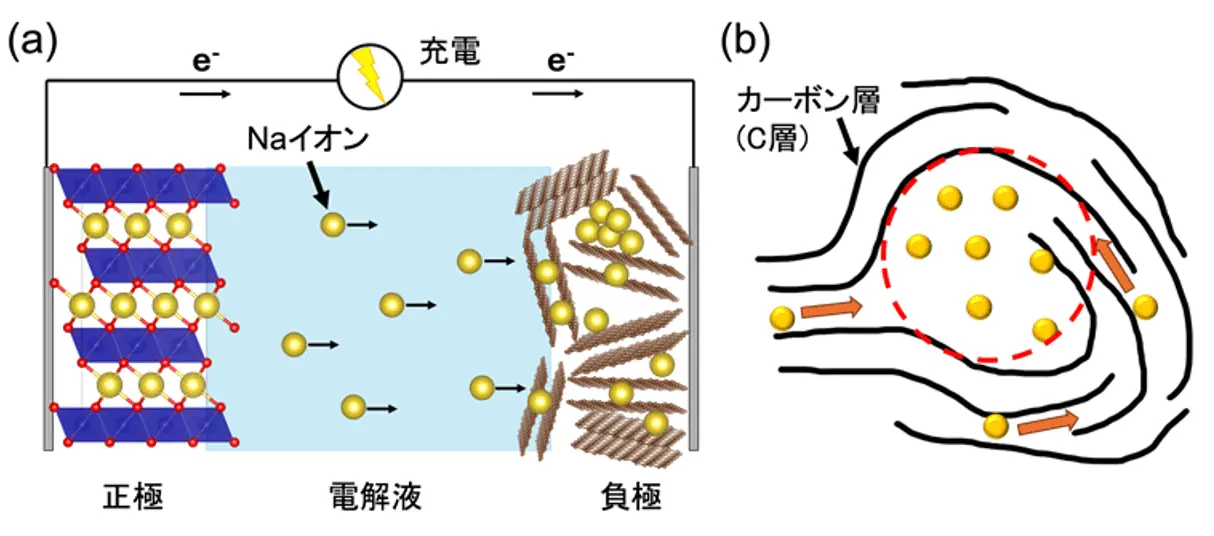
図1.(a)Naイオン電池の模式図(充電時)。(b)ハードカーボン(HC)負極の想定図。黒線がカーボン(C)層、黄球がNaイオンを表す。赤破線がナノスケール(ナノ)孔領域に相当し、赤矢印がNaイオン拡散を示す。
<関連情報>
- https://www.isct.ac.jp/ja/news/uvp6rakl8c6w
- https://advanced.onlinelibrary.wiley.com/doi/10.1002/aenm.202505227
硬質炭素ナノ細孔におけるNaクラスター形成とNaイオン拡散の支配的過程の解明:DFT-MD研究 Unveiling Dominant Processes of Na Cluster Formation and Na-Ion Diffusion in Hard Carbon Nano-Pore: A DFT-MD Study
Che-an Lin, Huu Duc Luong, Ryoma Sasaki, Yoshitaka Tateyama
Advanced Energy Materials Published: 17 November 2025
DOI:https://doi.org/10.1002/aenm.202505227
Abstract
The pore filling by Na cluster formation in designated hard carbon (HC) anodes has been reported as a major origin of the extended plateau capacity for Na-ion battery. However, there is a lack of thorough insight into the mechanism of Na cluster formation. Furthermore, the factors causing sluggish Na-ion diffusion in HC are still unclear. In this work, these issues are addressed using density-functional-theory-based molecular dynamics with two parallel/distorted graphene sheets as models for the HC nano-pores and graphitic regions. The calculations demonstrated that capacitor-like Na-ion adsorption only takes place at the beginning of sodiation. With further sodiation, quasi-metallic Na cluster nucleates in the pore center instead of defect sites on the graphene sheets. It is also found that 1.5 nm is the most favorable pore size for the Na clustering. Regarding the sluggish experimentally measured Na-ion self-diffusivity (≈10−11 cm2 s−1), the present HC models indicate that Na ions show locally high diffusivity in the pores and graphitic regions at 300K (≈10−5–10−6 cm2 s−1), while the transition regions between large and small interlayer distance are likely to be the rate limiting step for Na-ion diffusion in HC due to the drastic change in Na-ion charge.