2025-11-18 千葉大学
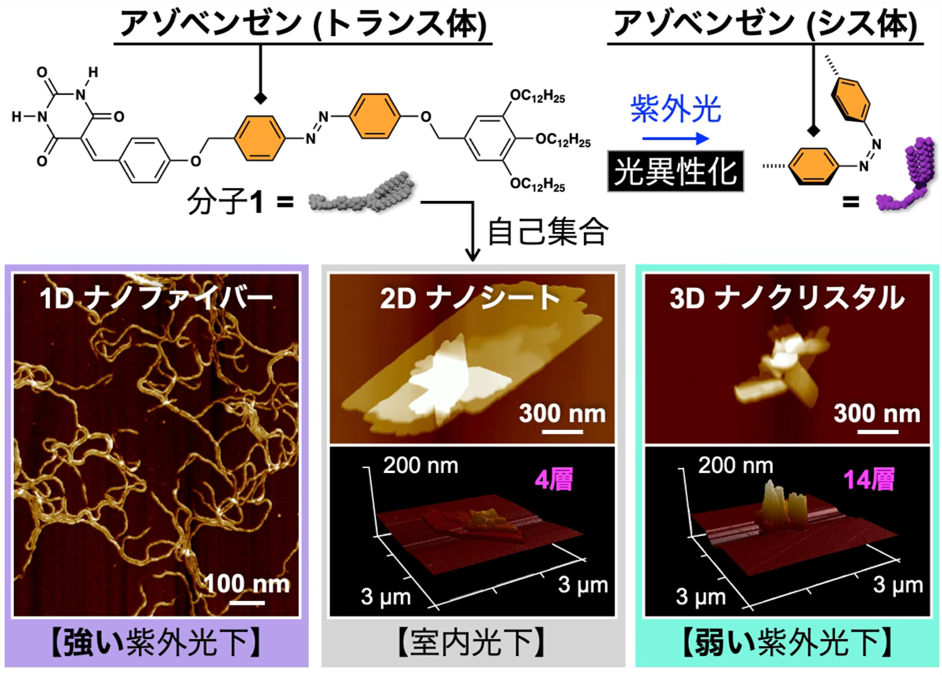
図1. 分子1の化学構造(上)および異なる強度の紫外光照射下で分子1が形成する分子集合体のAFM像(下)
<関連情報>
- https://www.chiba-u.ac.jp/news/research-collab/post_600.html
- https://www.chiba-u.ac.jp/news/files/pdf/251118_Polymers.pdf
- https://www.cell.com/chem/fulltext/S2451-9294(25)00409-7
次元的に異なるナノ多形体に向けた光強度依存の非平衡過程 Light-intensity-dependent out-of-equilibrium processes toward dimensionally distinct nanopolymorphs
Kenta Tamaki ∙ Hiroki Hanayama ∙ Sougata Datta ∙ … ∙ Masaki Kawano ∙ Christian Ganser ∙ Shiki Yagai
Chem Published:November 17, 2025
DOI:https://doi.org/10.1016/j.chempr.2025.102818
The bigger picture
Replicating the remarkable functionality and adaptability of biological supramolecular assemblies in synthetic systems remains a major challenge, largely due to the inherent limitations of conventional thermodynamically stable assemblies, which lack the capability to respond rapidly and flexibly to environmental changes. In response, increasing attention has turned toward the development of artificial out-of-equilibrium systems that, akin to living organisms, continuously consume energy to sustain dynamic structures and functions. Although a number of artificial out-of-equilibrium systems powered by chemical fuels or light have been reported, they have been limited to binary switching and have yet to achieve versatile control over multiple out-of-equilibrium states. In this study, by integrating supramolecular polymorphism with azobenzene photoisomerization, we constructed a light-driven out-of-equilibrium supramolecular system that exhibits dynamic transitions between three distinct assembly states with clearly different dimensionalities, simply by tuning the light intensity. By employing high-speed atomic force microscopy, we directly visualized and elucidated the underlying mechanisms of these dynamic structural transformations. Our findings provide a new platform for designing artificial materials that approach biological systems in adaptability and function, paving the way toward advanced, highly responsive smart molecular materials.
Highlights
- Light-intensity-dependent out-of-equilibrium self-assembly system
- Single-crystal-guided structural elucidation of a 2D supramolecular nanosheet
- Real-time observation of dynamic out-of-equilibrium processes
- Light-driven facet-selective transformation and Ostwald ripening of nanosheet
Summary
Molecular assemblies that form distinct out-of-equilibrium states in response to varying energy inputs represent a promising platform for designing advanced, autonomous adaptive materials capable of flexibly and diversely responding to environmental stimuli. Herein, we describe a supramolecular polymer system that integrates azobenzene photoisomerization with hydrogen-bond-directed supramolecular polymorphism, enabling the formation of distinct out-of-equilibrium states under varied light intensities. trans isomers of an azobenzene derivative featuring a barbituric acid merocyanine unit self-assemble into lamellar crystals via two-dimensional nanosheet stacking. Ultraviolet light irradiation of a nanosheet dispersion in nonpolar media at different intensities modulates the proportion of cis isomers, eliciting unique out-of-equilibrium states. Specifically, a strong light facilitates the coassembly of trans and cis isomers into one-dimensional nanofibers through hydrogen bond rearrangement, whereas weaker light drives Ostwald ripening, transforming two-dimensional nanosheets into three-dimensional multilayered structures. High-speed atomic force microscopy reveals the intricate dynamic processes driving these transitions.