2025-11-13 核融合科学研究所
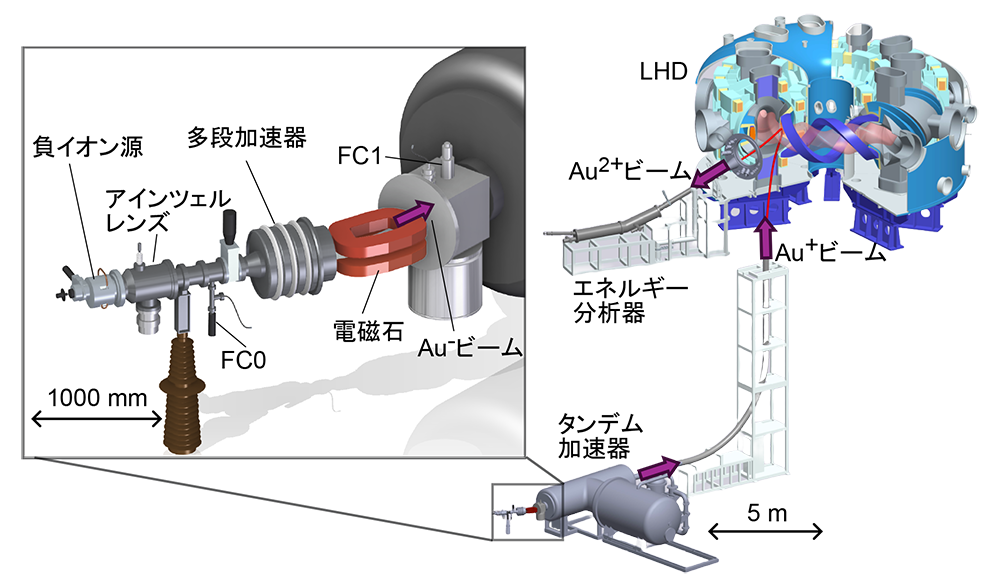
図1 LHDとHIBP計測器。左枠内は負イオン源からタンデム加速器入射側の拡大図。
<関連情報>
- https://www.nifs.ac.jp/news/research/251113.html
- https://iopscience.iop.org/article/10.1088/1741-4326/ae0da1
核融合プラズマ診断のための多段加速器における空間電荷緩和によるビーム輸送の強化 Enhanced beam transport via space charge mitigation in a multistage accelerator for fusion plasma diagnostics
M. Nishiura, K. Nakamura, K. Ueda, A. Shimizu, H. Takubo, M. Kanda, T. Ido and M. Okamura
Nuclear Fusion Published: 13 October 2025
DOI:10.1088/1741-4326/ae0da1
Abstract
Efficient transport of high-current negative ion beams is critical for accurate plasma potential diagnostics using heavy-ion beam probe (HIBP) systems in magnetically confined fusion plasmas. However, strong space-charge effects often degrade transport efficiency, particularly for heavy ions such as Au−. In this study, we demonstrate a substantial improvement in beam transport by introducing an electrostatic lens effect through optimized voltage allocation in a multistage acceleration system. Numerical simulations using IGUN, supported by experiments with the Large Helical Device-HIBP system, show that this approach effectively suppresses space-charge-induced beam divergence and loss. Without requiring mechanical modifications to the beamline, the optimized configuration enables a 2–3 fold increase in Au− beam current injected into the tandem accelerator. Consequently, plasma potential measurements were extended to higher-density plasmas, reaching line-averaged electron densities up to 1.75×10¹⁹ m−3 with improved signal-to-noise ratio. This technique offers a compact, practical, and highly effective solution for transporting high-current heavy-ion beams under space-charge-dominated conditions. Beyond its impact on plasma diagnostics, the method is broadly applicable to a wide range of accelerator systems, including those used in scientific and industrial applications where high-intensity beam transport is required.