2025-11-07 ミュンヘン大学(LMU)
- https://www.lmu.de/en/newsroom/news-overview/news/geography-ways-to-achieve-more-accurate-carbon-budgets.html
- https://www.nature.com/articles/s43017-025-00730-6
土地利用CO2フラックス推定における差異と不確実性 Differences and uncertainties in land-use CO2 flux estimates
Wolfgang A. Obermeier,Clemens Schwingshackl,Raphael Ganzenmüller,Giacomo Grassi,Viola Heinrich,Ingrid T. Luijkx,Ana Bastos,Philippe Ciais,Stephen Sitch & Julia Pongratz
Nature Reviews Earth & Environment Published:30 October 2025
DOI:https://doi.org/10.1038/s43017-025-00730-6
Abstract
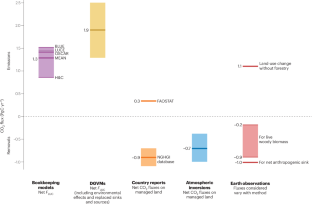
Accurately estimating carbon dioxide (CO2) fluxes from land use and land-use change (FLUC) is critical to assessing nationally determined contributions and progress towards climate targets. In this Perspective, we compare five FLUC estimation approaches, discuss the origins of large uncertainties and discrepancies in estimates and consider how to improve estimate accuracy and better align individual estimates. Global FLUC estimates between 2000 and 2023 range from net emissions of 1.9 ± 0.6 PgC yr−1 (based on dynamic global vegetation models) to net removals of −1.0 PgC yr−1 (based on Earth observations), with other estimates from bookkeeping models, country reports and atmospheric inversions falling within this range. Discrepancies arise from each approach using different definitions for FLUC, the spatial extent of managed land and including degradation and environmental effects to varying degrees. As a result, each approach accounts for different fluxes and land areas. Uncertainties within individual estimates are attributed to quality of land-use data, observational constraints and incomplete process consideration. These uncertainties can be reduced through better separation of anthropogenic and natural CO2 fluxes, including the effects of anthropogenically driven ecosystem degradation and improving model parameterizations. Thus, future research should prioritise unambiguous and consistent definitions and conducting systematic evaluations against each other to improve the translation and harmonization of FLUC estimates, which is essential to support effective climate policies and optimize land-based climate change mitigation.
Key points
- Bookkeeping model estimates of CO2 fluxes from land use and land-use change (FLUC), which average 1.3 (0.8–1.5) PgC yr−1 between 2000 and 2023, can be improved by better accounting for environmental effects and spatial heterogeneity in carbon densities and comprehensively including land management and anthropogenic degradation.
- FLUC estimates from dynamic global vegetation models (1.9 ± 0.6 PgC yr−1, 2000-2023) can be improved by excluding unrealized carbon uptake in cleared forests, implementing ecosystem demography and providing CO2 flux estimates for specific drivers.
- National Greenhouse Gas Inventory FLUC estimates (−0.9 ± 0.2 PgC yr−1, 2000–2023) can be improved by disaggregating specific management activities and comprehensively including fluxes from all land uses and carbon pools, including soils. Enhanced support for the compilation of inventories in resource-constrained countries is also needed.
- Earth observation approaches (with FLUC estimates ranging between −1.0 PgC yr−1 in 2001–2023 and 1.1 PgC yr−1 in 2000–2015) can be improved through enhanced separation of natural and anthropogenic CO2 fluxes and improved representation of forest degradation and regrowth via long-term time series of biomass and land cover.
- FLUC estimates from atmospheric inversions (−0.7 ± 0.3 PgC yr−1, 2000–2023) can be improved through expanding in situ and satellite observations of atmospheric CO2, further developing atmospheric transport models and enhancing the spatial resolutions of inversion systems.