2025-10-31 中国科学院(CAS)
<関連情報>
- https://english.cas.cn/newsroom/research_news/infotech/202511/t20251103_1095317.shtml
- https://www.nature.com/articles/s41598-025-18963-2
GGWでは土地生産性が低下しているが、回復に対する人間の貢献は劣化をはるかに上回っている Land productivity declines in the GGW while human contributions to restoration far outweighing degradation
Yubo Zhi,Xiaosong Li,Tong Shen,Graciela Metternicht,Anne Grainger,Yude Pan,Qi Lu & Amos Tiereyangn Kabo-Bah
Scientific Reports Published:07 October 2025
DOI:https://doi.org/10.1038/s41598-025-18963-2
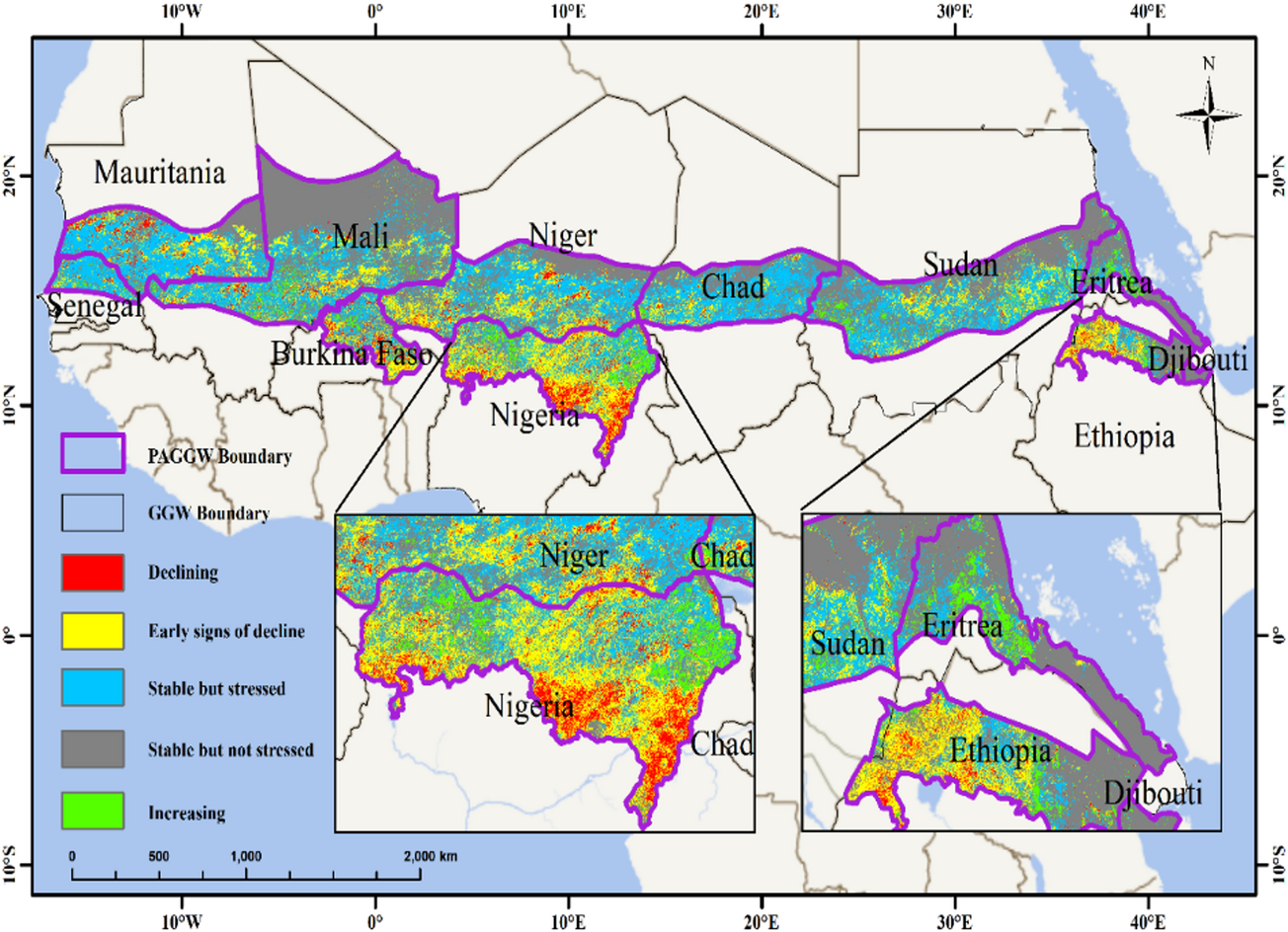
Abstract
The African Great Green Wall (GGW) initiative is a major effort to achieve the Sustainable Developed Goals (SDG) 15.3 target of Land Degradation Neutrality (LDN) in the Sahel regions. This study provides a comprehensive assessment of the land productivity dynamics (LPD) within the GGW from 2013 to 2022, serving as a sub-indicator for SDG 15.3.1 reporting and analyzes the key factors influencing these changes. Our results indicate that the land degradation outpaces restoration in the GGW, with 4.93% of the area experiencing declining land productivity (LP) compared to only 3.44% showing improvement. This suggesting that the effectiveness of the GGW initiative has not met expectations, highlighting the need for more targeted interventions. Among the drivers of LPD, we found that land cover change (LCC) accounts for the largest share of LPD increase (30.97%), while climate change (CLI) is the main contributor to declining LP (43.51%). The impact of CO2 fertilization is similar to that of LCC, whereas nitrogen deposition (NDE) has a minimal influence. Among human-driven factors, forest loss, cropland abandonment and deforestation for cultivation are the primary causes of declining LP. Conversely, forest expansion and reclamation of bare land for agriculture are the main contributors to increasing LP. Our findings demonstrate that while climate change remains a major challenge, human-driven land management strategies can play a pivotal role in restoring degraded land. The GGW initiative requires more coordinated, science-based strategies to achieve its full potential by 2030. By integrating climate adaptation, land restoration policies, and sustainable land-use practices, the GGW can enhance both ecological resilience and community livelihoods across the Sahel.