2025-10-31 名古屋大学
<関連情報>
- https://www.nagoya-u.ac.jp/researchinfo/result/2025/10/post-894.html
- https://www.nagoya-u.ac.jp/researchinfo/result/upload_images/20251031_sci.pdf
- https://www.nature.com/articles/s41467-025-64588-4
走査トンネル顕微鏡によるカゴメ金属のループカレント相におけるスイッチング可能な準粒子干渉カイラリティの起源 Origin of switchable quasiparticle-interference chirality in loop-current phase of kagome metals measured by scanning-tunneling-microscopy
Seigo Nakazawa,Rina Tazai,Youichi Yamakawa,Seiichiro Onari & Hiroshi Kontani
Nature Communications Published:29 October 2025
DOI:https://doi.org/10.1038/s41467-025-64588-4
Abstract
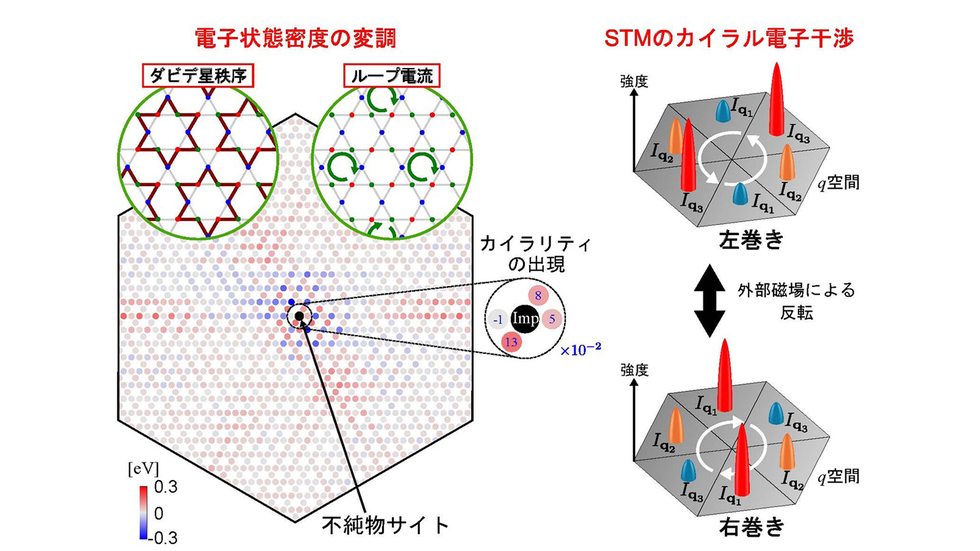
In the kagome superconductors AV3Sb5 (A=Cs,Rb,K), a cascade of correlated electron phases cause exotic symmetry-breaking quantum states. In particular, the dissipationless chiral loop-current phase has been attracting increasing attention. A crucial clue is offered by the chirality of the quasiparticle interference signal observed in scanning tunneling microscopy. However, the connection between loop-current chirality and quasiparticle interference chirality remains poorly understood. Here, we reveal theoretically that a pronounced chiral quasiparticle interference signal emerges in the extremely dilute impurity regime ( ≲ 0.1%). A single impurity at site Z induces a quasiparticle interference chirality χZ = ± 1, determined by the direction of the Z3 nematicity, itself set by the relative position of the loop-current order in the star-of-David charge-density-wave phase. Notably, even a small magnetic field can smoothly switch the chirality, leading to field-induced shear lattice strain consistent with recent experiments. Our theoretical study provide key insights into the nature of the loop-current-induced symmetry-breaking states in kagome metals.