2025-10-30 ニューヨーク大学(NYU)
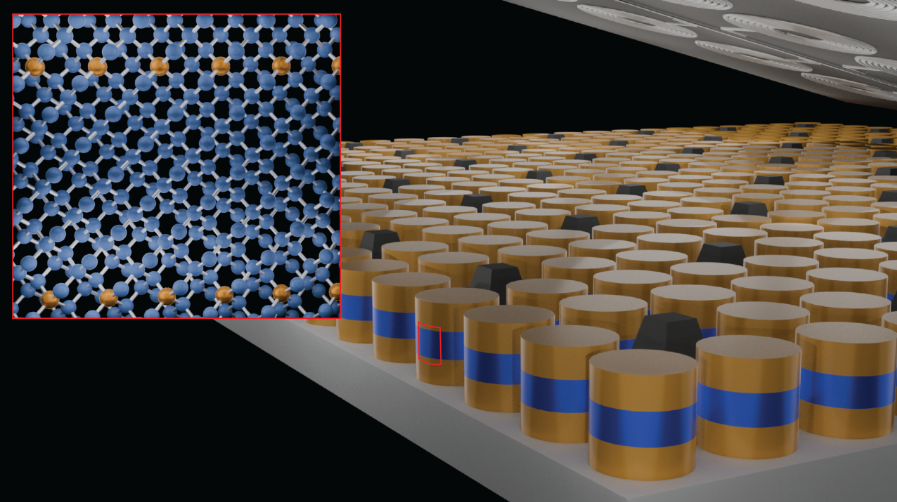
Josephson junction structures—quantum devices made of two superconductors and a thin non-superconducting barrier—using different forms of germanium (Ge): super-Ge (in gold), semiconducting Ge (in blue), and super-Ge on wafer-level scale. Millions of Josephson junction pixels (10 micrometer square) can be created with this new material stack on wafer scale. Inset shows crystalline form of Super-Ge on the same matrix of semiconductor Ge, a key for crystalline Josephson junction. Image by Patrick Strohbeen/NYU
<関連情報>
- https://www.nyu.edu/about/news-publications/news/2025/october/scientists-create-new-type-of-semiconductor-that-holds-supercond.html
- https://www.nature.com/articles/s41565-025-02042-8
置換型GaハイパードープGeエピタキシャル薄膜における超伝導 Superconductivity in substitutional Ga-hyperdoped Ge epitaxial thin films
Julian A. Steele,Patrick J. Strohbeen,Carla Verdi,Ardeshir Baktash,Alisa Danilenko,Yi-Hsun Chen,Jechiel van Dijk,Frederik H. Knudsen,Axel Leblanc,David Perconte,Lianzhou Wang,Eugene Demler,Salva Salmani-Rezaie,Peter Jacobson & Javad Shabani
Nature Nanotechnology Published:30 October 2025
DOI:https://doi.org/10.1038/s41565-025-02042-8
Abstract
Doping-induced superconductivity in group-IV elements may enable quantum functionalities in material systems accessible with well-established semiconductor technologies. Non-equilibrium hyperdoping of group-III atoms into C, Si or Ge can yield superconductivity; however, its origin is obscured by structural disorder and dopant clustering. Here we report the epitaxial growth of hyperdoped Ga:Ge films and trilayer heterostructures by molecular-beam epitaxy with extreme hole concentrations (nh = 4.15 × 1021 cm−3, 17.9% Ga substitution) that yield superconductivity with a critical temperature of Tc = 3.5 K. Synchrotron-based X-ray absorption and scattering methods reveal that Ga dopants are substitutionally incorporated within the Ge lattice, introducing a tetragonal distortion to the crystal unit cell. Our findings, corroborated by first-principles calculations, suggest that the structural order of Ga dopants creates a narrow band for the emergence of superconductivity in Ge, establishing hyperdoped Ga:Ge as a low-disorder, epitaxial superconductor–semiconductor platform.