2025-10-29 電気通信大学
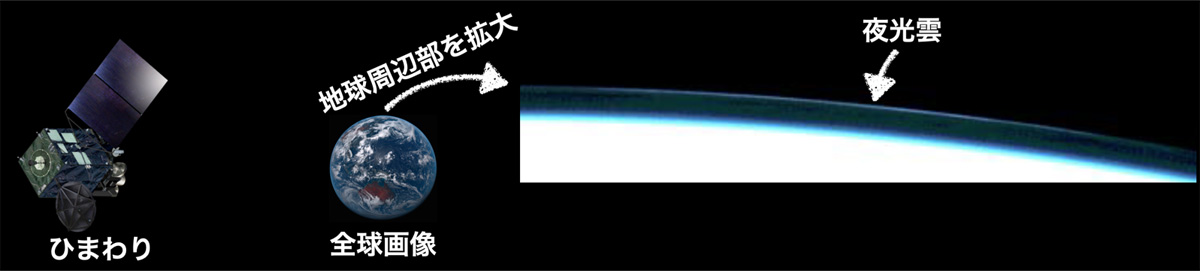
図1: 静止軌道衛星ひまわりによる夜光雲の観測
<関連情報>
- https://www.uec.ac.jp/news/newsrelease/2025/20251029_7253.html
- https://www.uec.ac.jp/about/publicity/news_release/2025/pdf/20251029_7253.pdf
- https://earth-planets-space.springeropen.com/articles/10.1186/s40623-025-02298-3
2022 年のフンガ・トンガ – フンガ・ハアパイ噴火によって引き起こされた水蒸気異常に対する極地中圏雲の反応 Responses of polar mesospheric clouds to water vapor anomalies caused by the 2022 Hunga Tonga–Hunga Ha’apai eruption
Y. Moriyama,T. T. Tsuda,Y. Ando,H. Suzuki,H. Nakagawa,T. Nishiyama,Y.-M. Tanaka,K. T. Murata & J. Yue
Earth, Planets and Space Published:DOI:https://doi.org/10.1186/s40623-025-02298-3
Abstract
The H2O plume, injected by the Hunga Tonga–Hunga Ha’apai (HTHH) eruption on 15 January 2022, spread and reached the high-latitude mesopause regions 2 years after the eruption. To investigate the relationships between polar mesospheric clouds (PMCs) and the HTHH eruption-originated H2O anomalies, we have analyzed PMC occurrence rates (ORs), temperature, and water vapor volume mixing ratios (H2O VMRs), based on observational data from Himawari-8/Advanced Himawari Imager (AHI), Himawari-9/AHI, and Aura/Microwave Limb Sounder. To focus the PMC responses to the H2O anomalies, we extracted the temperature-independent components in the PMC OR variability, which is defined as ΔPMC. As a result, we found a significant ΔPMC increase (15±5%) in January 2024 in the Southern Hemisphere (SH), which was associated with the HTHH eruption-induced water vapor increase (0.88±0.04 ppmv) at 77.8–87.9 km altitudes in January 2024 in the SH. The finding would be, for the first time, observational evidence of PMC variations induced by volcanic eruptions, which is a striking PMC topic that has long been discussed since the 1883 Krakatoa eruption.