2025-10-16 中国科学院(CAS)
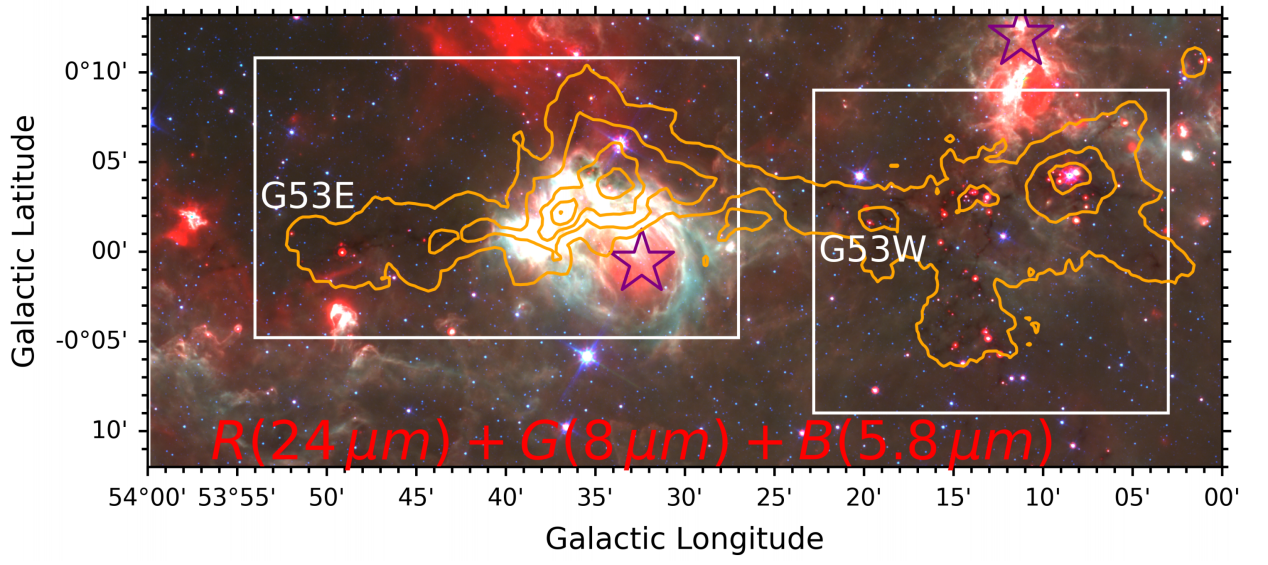
The spitzer three-color composite image of G53. The orange contours represent 13CO(1-0) integrated intensity. (Image by XAO)
<関連情報>
- https://english.cas.cn/newsroom/research_news/phys/202510/t20251024_1094805.shtml
- https://www.aanda.org/articles/aa/full_html/2025/09/aa53390-24/aa53390-24.html
端部優位の崩壊とハブフィラメントシステムの事例研究、G53 A case investigation of an end-dominated collapse and hub-filament system, G53
Dezhao Meng, Jarken Esimbek, Christian Henkel, Jianjun Zhou, Gang Wu, Xindi Tang, Dalei Li, Yuxin He, Toktarkhan Komesh, Yingxiu Ma, Kadirya Tursun, Dongdong Zhou, Willem Baan, Andrej M. Sobolev, Serikbek Sailanbek and Qaynar Jandaole
Astronomy & Astrophysics Published:12 September 2025
DOI:https://doi.org/10.1051/0004-6361/202453390
Abstract
Aims. G53 is an active star formation region with approximately 300 young stellar object (YSO) candidates and exhibits a long filament in CO (VLSR ~ 23 km s–1). To date, there has been no detailed study of its filament characteristics. We therefore explored the kinematics of the filament in the G53 region and the star formation activities triggered along it by combining data from various facilities.
Methods. We primarily utilized archival 13CO (1–0) data from the Galactic Ring Survey and NH3(1,1) observations from the Nanshan 26-meter radio telescope. Additionally, we incorporated 12CO (3–2) data from the CO High-Resolution Survey, as well as infrared data from Spitzer and Herschel, to study the G53 region. NH3 (1,1) was used to trace the ends of the molecular cloud G53 (G53W and G53E), while 13CO (1–0) was used to map the entire molecular cloud. We used CRISPY to identify the filament spine in the 13CO (1–0) position-position-velocity cube. Position-velocity diagrams along the filament spine were analyzed to extract kinematic information. Numerical simulations of a turbulent filament were conducted for comparison with the observed kinematics of G53. Additionally, YSOs in G53 were collected to evaluate the star formation activity.
Results. The velocity-integrated intensity map of 13CO (1–0) and the H2 column density map indicate that the filament G53 appears to be undergoing an end-dominated collapse (EDC) process. Position-velocity diagrams of 13CO (1–0) show that in G53W, the clumps C2 and C4 are possibly moving toward each other while accreting surrounding material. Our numerical simulations of the EDC scenario indicate that an isothermal filament initially fragments into several clumps due to turbulence, which subsequently merge at the ends. This further adds to the credibility of our hypothesis regarding the approaching motion of C2 and C4 in G53W. NH3 signals are detected only in the G53W and G53E regions, with significantly stronger signals in G53W. In G53W, the NH3(14) data reveal a hub-filament system (HFS) centered around C2. The analysis of NH3(1,1) shows a strong correlation between the magnitude of the velocity gradient and the velocity dispersion in the G53W region, suggesting that the accumulation of material in this area contributes to large-scale turbulence. Additionally, C2, located at the center of the HFS, exhibits a higher star formation efficiency than other regions in G53.