2025-10-24 タフツ大学
<関連情報>
- https://now.tufts.edu/2025/10/24/addressing-population-disparities-near-worst-superfund-sites
- https://www.nature.com/articles/s41467-025-63607-8
米国のコミュニティを置き去りにしないスーパーファンドサイトの公平な浄化 Equitable cleanup of Superfund sites leaving no U.S. community behind
Mohammed Azhar,Farshid Vahedifard,Dustin C. Brown,Alireza Ermagun & Kaveh Madani
Nature Communications Published:29 September 2025
DOI:https://doi.org/10.1038/s41467-025-63607-8
Abstract
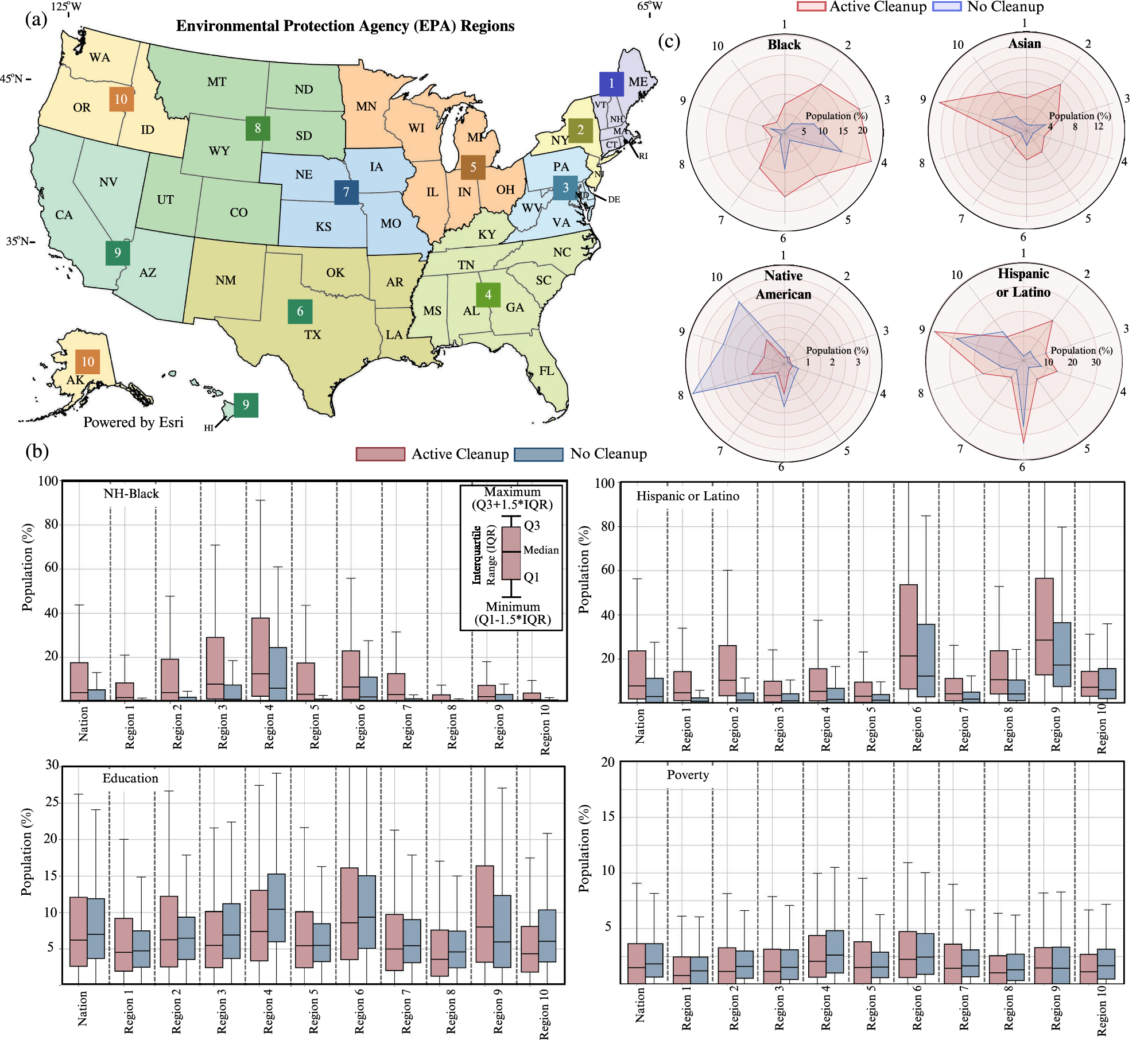
Superfund sites are recognized as the most contaminated locations across the U.S. Here we introduce two metrics: (i) the disparity percentage, which quantifies the overrepresentation of vulnerable populations in proximity to Superfund sites, and (ii) the Superfund exposure score, which evaluates the population proportion in a geographical region affected by such proximity. We employ the metrics to develop an Action Priority Matrix (APM) categorizing states and regions into four tiers of cleanup priorities, informed by a spatial analysis of 13,453 Superfund sites across the U.S. About 80% of the U.S. population live within 10 km of at least one Superfund site, with nearly 60% of them residing in areas lacking any cleanup efforts. Asian, Black, and disadvantaged populations are found to be disproportionately overrepresented in Superfund host block groups. Seven states are identified for urgent cleanups using the proposed APM, providing a systematic approach to equitable resource allocation for cleanups.