2025-10-22 カリフォルニア大学ロサンゼルス校(UCLA)
Yoo Jung Kim/UCLA
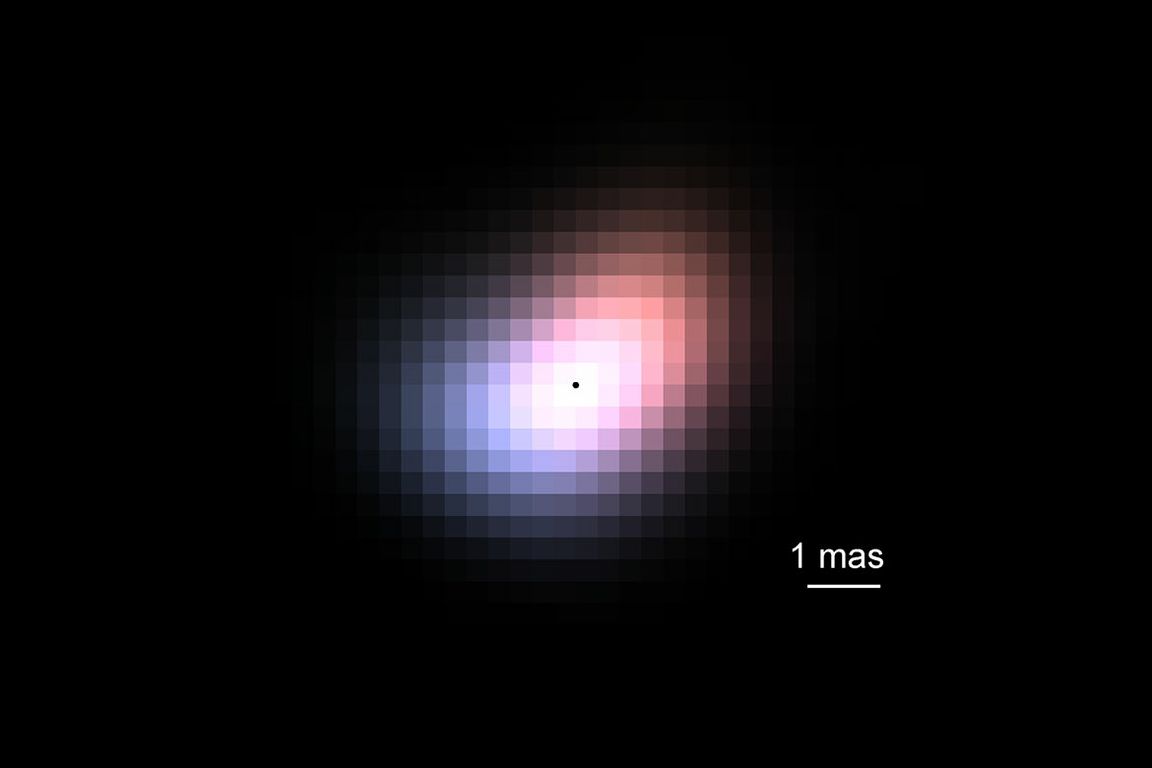
Reconstructed image of the compact, fast-rotating asymmetric disc around β CMi. The white scale bar at the bottom right marks 1 milliarcsecond — equivalent to a 6 feet scale at the distance of the moon.
<関連情報>
- https://newsroom.ucla.edu/releases/telescope-hack-peers-deeper-into-universe
- https://iopscience.iop.org/article/10.3847/2041-8213/ae0739
フォトニックランタンを用いた回折限界以下の天文測定の天空実証 On-sky Demonstration of Subdiffraction-limited Astronomical Measurement Using a Photonic Lantern
Yoo Jung Kim, Michael P. Fitzgerald, Sébastien Vievard, Jonathan Lin, Yinzi Xin, Miles Lucas, Olivier Guyon, Julien Lozi, Vincent Deo, Elsa Huby,…
The Astrophysical Journal Letters Published: 2025 October 22
DOI:10.3847/2041-8213/ae0739
Abstract
Resolving fine details of astronomical objects provides critical insights into their underlying physical processes. This drives in part the desire to construct ever-larger telescopes and interferometer arrays and to observe at shorter wavelengths to lower the diffraction limit of angular resolution. Alternatively, one can aim to overcome the diffraction limit by extracting more information from a single telescope’s aperture. A promising way to do this is spatial-mode-based imaging, which projects a focal-plane field onto a set of spatial modes before detection, retaining focal-plane phase information that is crucial at small angular scales but typically lost in intensity imaging. However, the practical implementation of mode-based imaging in astronomy from the ground has been challenged by atmospheric turbulence. Here, we present the first on-sky demonstration of a subdiffraction-limited mode-based measurement, using a photonic-lantern-fed spectrometer installed on the Subaru Coronagraphic Extreme Adaptive Optics instrument at the Subaru Telescope. We introduce a novel calibration strategy that mitigates time-varying wave-front error and misalignment effects, leveraging simultaneously recorded focal-plane images and using a spectral-differential technique that self-calibrates the data. Observing the classical Be star β CMi, we detect spectral-differential spatial signals and reconstruct images of its Hα-emitting disk. We achieve an unprecedented Hα photocenter precision of ∼50 μas in about 10 minutes of observation with a single telescope, measuring the disk’s nearside–farside asymmetry for the first time. This work demonstrates the high precision, efficiency, and practicality of photonic mode-based imaging techniques in recovering subdiffraction-limited information, opening new avenues for high-angular-resolution spectroscopic studies in astronomy.