2025-10-21 シカゴ大学(UChicago)
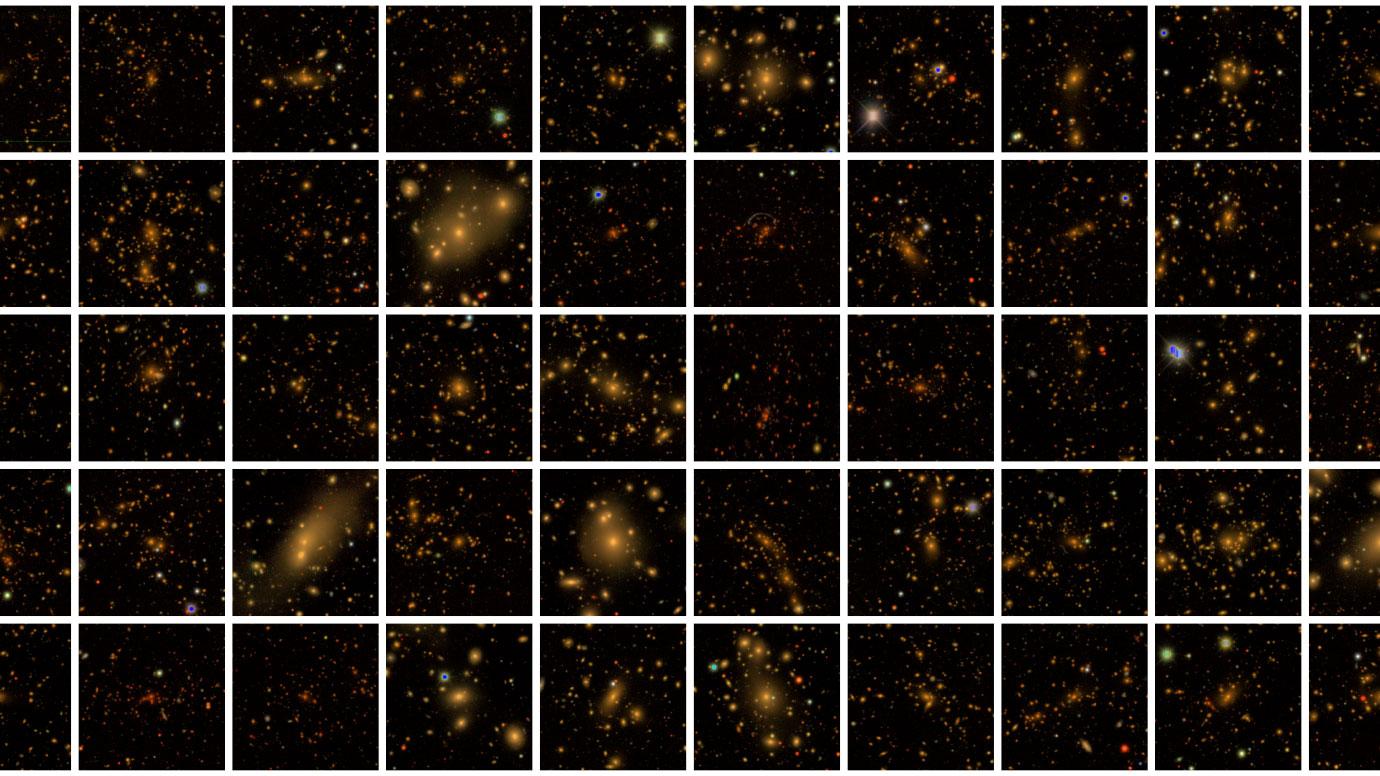
A new study catalogues the universe by mapping huge clusters of galaxies—some of the largest known objects in the universe—offering new insight into how the universe first formed and the rules that govern it today.Image courtesy of the Dark Energy Survey
<関連情報>
- https://news.uchicago.edu/story/scientists-release-new-survey-biggest-objects-universe
- https://journals.aps.org/prd/abstract/10.1103/ynqj-6hsb
- https://journals.aps.org/prd/abstract/10.1103/PhysRevD.105.023520
ダークエネルギーサーベイ:マルチプローブクラスター宇宙論のモデリング戦略と6年間のデータセット全体の検証 Dark energy survey: Modeling strategy for multiprobe cluster cosmology and validation for the full six-year dataset
Chun-Hao To, Elisabeth Krause, Chihway Chang, Hao-Yi Wu, Risa H. Wechsler, Eduardo Rozo, David H. Weinberg, D. Anbajagane, S. Avila et al. (DES Collaboration)
Physical Review D Published: 18 September, 2025
DOI: https://doi.org/10.1103/ynqj-6hsb
Abstract
We introduce an updated To&Krause2021 model for joint analyses of cluster abundances and large-scale two-point correlations of weak lensing and galaxy and cluster clustering (termed CL+3×2 pt analysis) and validate that this model meets the systematic accuracy requirements of analyses with the statistical precision of the final Dark Energy Survey (DES) Year 6 (Y6) dataset. The validation program consists of two distinct approaches, (i) identification of modeling and parametrization choices and impact studies using simulated analyses with each possible model misspecification and (ii) end-to-end validation using mock catalogs from customized Cardinal simulations that incorporate realistic galaxy populations and DES-Y6-specific galaxy and cluster selection and photometric redshift modeling, which are the key observational systematics. In combination, these validation tests indicate that the model presented here meets the accuracy requirements of DES-Y6 for CL+3×2 pt based on a large list of tests for known systematics. In addition, we also validate that the model is sufficient for several other data combinations: the CL+GC subset of this data vector (excluding galaxy–galaxy lensing and cosmic shear two-point statistics) and the CL+3×2 pt+BAO+SN (combination of CL+3×2 pt with the previously published Y6 DES baryonic acoustic oscillation and Y5 supernovae data).
ダークエネルギーサーベイ3年目の成果:銀河のクラスタリングと弱い重力レンズ効果による宇宙論的制約 Dark Energy Survey Year 3 results: Cosmological constraints from galaxy clustering and weak lensing
T. M. C. Abbott, M. Aguena, A. Alarcon, S. Allam, O. Alves, A. Amon, F. Andrade-Oliveira, J. Annis, S. Avila et al. (DES Collaboration)
Physical Review D Published: 13 January, 2022
DOI: https://doi.org/10.1103/PhysRevD.105.023520
Abstract
We present the first cosmology results from large-scale structure using the full 5000 deg2 of imaging data from the Dark Energy Survey (DES) Data Release 1. We perform an analysis of large-scale structure combining three two-point correlation functions (3×2pt): (i) cosmic shear using 100 million source galaxies, (ii) galaxy clustering, and (iii) the cross-correlation of source galaxy shear with lens galaxy positions, galaxy–galaxy lensing. To achieve the cosmological precision enabled by these measurements has required updates to nearly every part of the analysis from DES Year 1, including the use of two independent galaxy clustering samples, modeling advances, and several novel improvements in the calibration of gravitational shear and photometric redshift inference. The analysis was performed under strict conditions to mitigate confirmation or observer bias; we describe specific changes made to the lens galaxy sample following unblinding of the results and tests of the robustness of our results to this decision. We model the data within the flat ΛCDM and CDM cosmological models, marginalizing over 25 nuisance parameters. We find consistent cosmological results between the three two-point correlation functions; their combination yields clustering amplitude 8 =0.776+0.017−0.017 and matter density Ωm =0.339+0.032−0.031 in ΛCDM, mean with 68% confidence limits; 8 =0.775+0.026−0.024, Ωm =0.352+0.035−0.041, and dark energy equation-of-state parameter =−0.98+0.32−0.20 in CDM. These constraints correspond to an improvement in signal-to-noise of the DES Year 3 3×2pt data relative to DES Year 1 by a factor of 2.1, about 20% more than expected from the increase in observing area alone. This combination of DES data is consistent with the prediction of the model favored by the Planck 2018 cosmic microwave background (CMB) primary anisotropy data, which is quantified with a probability-to-exceed =0.13–0.48. We find better agreement between DES 3×2pt and Planck than in DES Y1, despite the significantly improved precision of both. When combining DES 3×2pt data with available baryon acoustic oscillation, redshift-space distortion, and type Ia supernovae data, we find =0.34. Combining all of these datasets with Planck CMB lensing yields joint parameter constraints of 8 =0.812+0.008−0.008, Ωm =0.306+0.004−0.005, ℎ =0.680+0.004−0.003, and ∑<0.13 eV (95% C.L.) in ΛCDM; 8 =0.812+0.008−0.008, Ωm =0.302+0.006−0.006, ℎ =0.687+0.006−0.007, and =−1.031+0.030−0.027 in CDM.